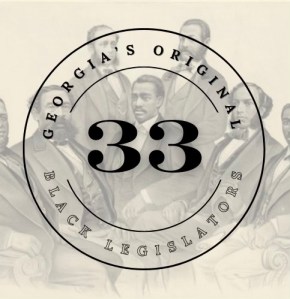
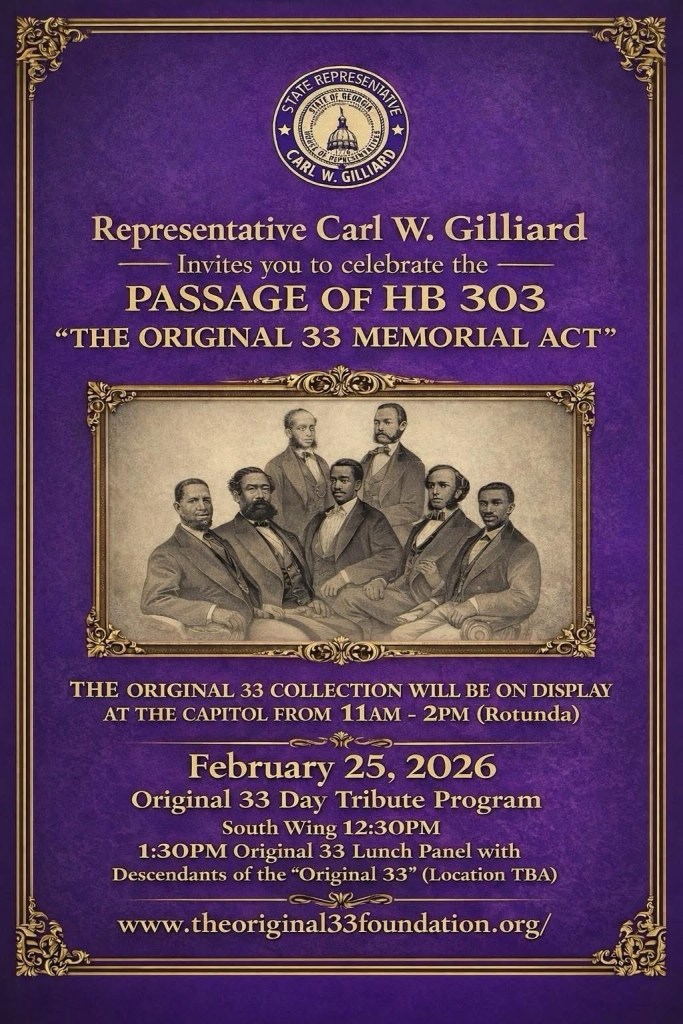
Join us to celebrate the Original 33 on February 25, 2026

A fundraiser has been launched to help cover the cost of Abram Colby‘s historic marker. If you get to the Gofundme and the goal has been met, all funds above the goal amount will be put towards future markers of the Original 33. The goal is to get one placed for each member.
https://www.wtoc.com/2025/03/31/hb-303-known-original-33-memorial-act-passes-ga-state-senate/
PRESS RELEASE
FOR IMMEDIATE RELEASE:
Contact: Betsy Theroux
Tuesday, April 22, 2025
(404) 656-3996
Kehl Mackesey
(404) 656-7589
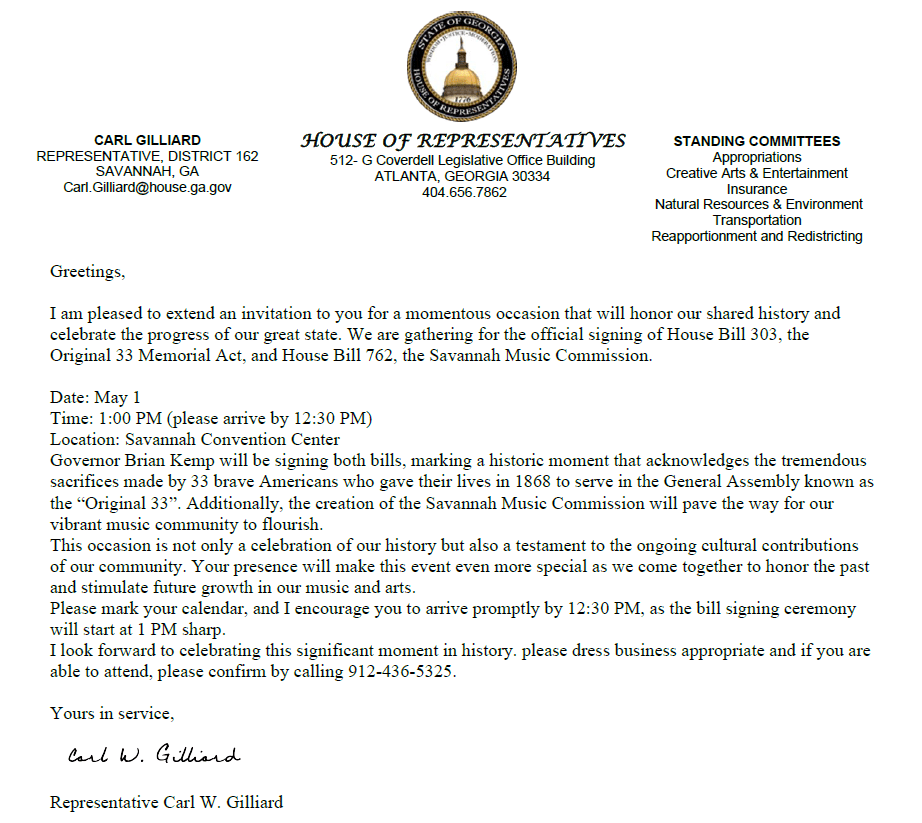
Rep. Carl Gilliard Urges Descendants of the Original 33 to Contact His Office
ATLANTA – State Representative Carl Gilliard (D-Savannah) urges descendants of the Original 33 to contact his office.
“Since the introduction and passage of HB 303, the Original 33 Memorial Act, we have heard from more relatives of the Original 33, and we want to ensure that we are able to reach out to every family member who would like to be involved in the process of memorializing these great men,” said Rep. Gilliard. “It is essential that we properly honor these courageous men and preserve the legacy of their sacrifice and services right here at the Georgia State Capitol.”
Rep. Gilliard requests that family members of the Original 33, Black legislators who were elected to the Georgia General Assembly in 1868 and expelled after Reconstruction, contact his office to provide input and participate in forthcoming memorial events. The Original 33’s names are listed as follows:
Senators Aaron Alpeoria Bradley; Tunis Campbell, Sr.; and George Wallace; and Representatives Thomas M. Allen; Eli Barnes; Thomas Beard; Edwin Belcher; Tunis Campbell, Jr.; Malcolm Claiborn; George H. Clower; Abram Colby; John T. Costin; Madison Davis; Monday Floyd; F. H. Fyall; Samuel Gardner; William A. Golden; William Guilford; William Henry Harrison; Ulysses L. Houston; Philip Joiner; George Linder; Robert Lumpkin; Romulus Moore; Peter O’Neal; James Ward Porter; Alfred Richardson; James M. Simms; Abraham Smith; Alexander Stone; Henry McNeal Turner; John Warren; Samuel Williams; and Jacob P. Hutchings.
House Bill 303, legislation Rep. Gilliard sponsored during the 2025 legislative session, would create the Original 33 Memorial Act. HB 303 received bipartisan support and passed both the House and Senate unanimously. The bill would allow for a monument, subject to the availability of private funds, honoring the Original 33, the Black legislators expelled from the General Assembly after the end of Reconstruction, to be placed on State Capitol grounds or in another prominent place.
The full text of HB 303 may be found here. To contact Rep. Gilliard, please call (912) 436-5325.
Representative Carl Gilliard represents the citizens of District 162, which includes a portion of Chatham County. He was first elected to the House of Representatives in 2016 and currently serves as Secretary of the Creative Arts & Entertainment. He also serves on the Appropriations Subcommittee on Economic Development, Insurance, Natural Resources & Environment, Reapportionment and Redistricting and Transportation committees.

Historian Greer Brigham has been researching the life of Abram Colby, one of The Original 33. Please take a moment to read his article on the website, Scalawag. With some Original 33 members, their stories have been hard to find. Brigham’s work unravels the story of Greene County’s Colby.
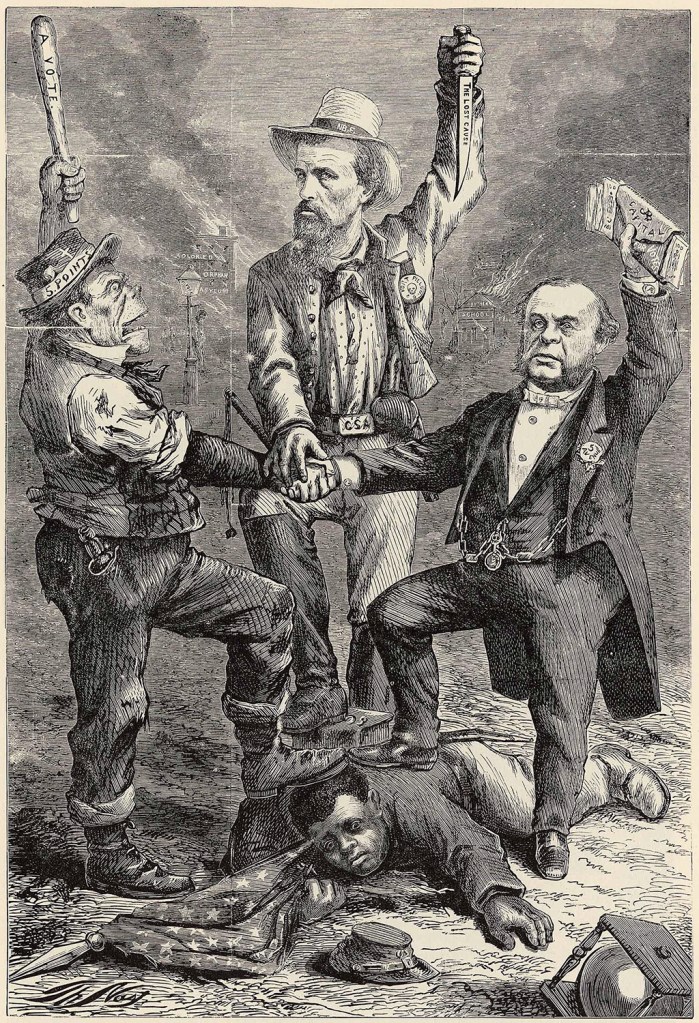
On Saturday, September 19, 1868, peaceful African-American marchers were threatened, beaten, tortured, and murdered in Camilla, Georgia, in what would become known as the Camilla Massacre. Over weeks of violence and terror, between nine and fifteen individuals lost their lives, and at least forty were wounded.
Leading up to the Massacre
The violence and killing by white Georgians during the Camilla Massacre was by no means an isolated occurrence despite some newspaper reports that cast the event as an anomaly. For the three years following the Civil War, white Georgians had attacked freedmen and republicans with little government intervention during Union occupation. This oversight perpetuated the strategy of enacting violence against Black activities as a legitimate strategy to keep former slaves in line with White Supremacy. While Black Georgians had earned the right to vote in Georgia’s 1868 Constitutional Convention passed the previous April, white Georgians used violence and quazi-clandestine organizations like the Ku Klux Klan to intimidate, suppress and disenfranchise African Americans in the ensuing months. Nonetheless, 33 Black Assemblymen persevered against threats of violence and voter intimidation and were elected to the Georgia House of Representatives and Senate only to be expelled from the Assembly by white legislators in early September 1868. Many events of white violence occurred at campaign events, Republican party events, and voter rights and registration events.
In protest of the unlawful expulsion, Black Assemblyman Philip Joiner (Rep- Dougherty County) led a 25-mile march from Albany to Camilla. This Mitchell County seat included several hundred Black Georgians (freemen) and a handful of white Georgians to attend a Republican political rally on the courthouse square. The violence that they met, while the largest in scale, was not uncommon in southwest Georgia at the time. These events demonstrated that during 1868, white citizens in southwest Georgia openly and frequently attacked freemen without repercussions. Repeated smaller attacks were met with no response from local authorities. Authorities refused to investigate, let alone prosecute, whites for attacking Black Georgians, further empowering the level, frequency, and brazenness of violence that whites could easily get away with.
Details of the Camilla Massacre
Black freedmen traveled from neighboring counties, including Dougherty, the most populous county of Black Georgians in southwest Georgia. Many were coming to hear Republicans William Pierce and John Murphy. Whites in the town, meanwhile, were preparing for a more violent set of events, with one telling a freedman, William Jones, that “he would bet a good deal that Murphy would not speak in Camilla that day.”
Participants in the march were shot at and attacked as they marched through Camilla towards the Mitchell County Courthouse despite their peaceful intentions. The violence began when a drunken resident, James Johns, began firing into the bandwagon that accompanied the marchers. A white mob then began an assault on the marchers, including the town’s sheriff, who formed a posse to hunt down the freedmen. Philip Joiner was shot in the attack.
The local sheriff and a white-only “citizens committee” in the majority-white town warned the Black and white activists that they would be met with violence and demanded that they surrender their guns. In 19th-century Georgia, carrying weapons was legal and customary for Black and white residents. Marchers refused to give up their guns and continued to the courthouse square, where a group of local whites, quickly deputized by the sheriff, fired upon them. The deputized group of private citizens was by no means uncommon in many violent events against Black Georgians. Vigilance committees were common occurrences as groups of private citizens took it upon themselves to administer law and order through violence. In many cases, local officials and even the U.S. military ignored these violent forms of vigilantism, which were little more than a structured version of a lynch mob.
This Camilla mob’s assault forced the marchers to retreat into the surrounding swamps as locals hunted them down and killed between nine and fifteen Black marchers, wounding forty others. Nicholas Johnson writes of the massacre that “Whites proceeded through the countryside over the next two weeks, beating and warning Negroes that they would be killed if they tried to vote in the coming election.” (Negros and the Gun: The Black Tradition of Arms, p 90-92.)
Ramifications
Following the massacre, U.S. Army officer O. H. Howard, the Sub-Assistant Commissioner for the Freedmen’s Bureau in Albany, dispatched a physician to Camilla to attend to the wounded while scores of others came to the Freedman Bureau’s office in Albany. In a letter to Col. John Randolph Lewis, Howard wrote:
Col.
I hurry Mr Schlotfeldt off with the fullest accounts I can command of the affair at Camilla, I believe the account I send you, to be correct without any exaggeration.
I wished to come up myself, but I dare not leave the freedmen here to themselves. If any one can prevent them from going to Camilla en masse I can do it, therefore, I remain here.
Unless vigorous measures are instituted, and troops are stationed here for the protection of all parties, there will be much bloodshed. I cannot restrain the people.
It will be useless for me to attempt to block the way of thousands, for any length of time, I must protect my family and let the contending parties fight it out.
It is coming
I have sent the Doctor to attend to the wounded.
Respy & Truly Yours
O. H. Howard
The letter highlights the brutal circumstances of the massacre as well as the officer’s concern that with tensions high the freedmen themselves may rise up to seek vengance against the white vigilantes in Camilla, Georgia. (See original text.)
The Camilla massacre led to extended military occupation in Georgia, Congressional testimony and an affidavit by Assemblyman Philip Joiner on September 23, 1868. ( See original text.) However, little was done to change the prosecution of whites perpetuating political and racial violence against freedmen. The Freedmen’s Bureau conducted an investigation and others in the Army also conducted investigations confirming that Black Georgians did not intend to cause violence in Camilla but simply were there to attend the Republicans’ speeches. At no point after the event or the investigation did the U.S. Army dispatch any troops to Camilla to further investigate or prosecute perpetrators. Local Camilla authorities also took no action to investigate or arrest any individuals in the incident. The Camilla courthouse itself mysteriously burned down months after the massacre destroying the county’s records. (Warren Royal and Diane Dixon, Camilla (Charleston: Arcadia Publishing, 2008), 14)
National newspaper coverage highlighted the political and racial tensions of the incident and in one case called it an assault on free speech. However, the actual events were often confused as editors took their own editorial license in coverage based on their region in the country and their readership.
Despite the large Black demographic in southwest Georgia counties, the 1868 vote went to a Democratic victory as poll workers in Dougherty county for example, stuffed republican ballots into their pockets and conducted other means of voter fraud to assure a Democratic win. The campaign violence and election fraud perpetrated by white Georgians did end up achieving their desired result.
Camilla was one of many acts of political violence in the Reconstruction South and was certainly not the last one. Other riots and acts of election violence occurred in Mobile (August 1869), Baton Rouge (November 1870), Macon (October 1872), and in Colfax, Louisiana (Easter Sunday, 1873) when an armed band of Klansman entered the town, attacking and murdering Blacks. Political violence continued through the mid-1870s as white Southerners continued to use effective violence to suppress Black voters and Black political candidates.
Public Acknowledgement of “The Camilla Massacre:”
It wasn’t until 1998 that The Camilla Massacre became part of Georgia’s history. Camilla residents publicly acknowledged and commemorated the massacre on September 19, 1998, 130 later.
Special acknowledgment to Joshua William Butler for their thesis written about the Camilla Massacre. Titled “Almost Too Terrible to Believe”: The Camilla, Georgia, Race Riot and Massacre, September 1868, it can be read here.
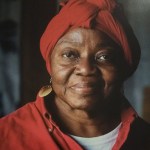
Many years ago, while researching Greene County, Georgia’s African American Historical Narrative, I discovered Abram Colby. From childhood to adulthood I always desired to know how I became a part of my community’s historical narrative. When I discovered Abram Colby, this began an unearthing and à feeling of ownership in this place. Abram Colby enslaved on the plantation of John Colby (Abram’s biological father) to a sixteen-year-old enslaved girl in Penfield, Georgia, around 1820. John Colby was one of Greene County’s wealthiest plantation owners. Although Abram’s experiences were that of enslavement. He esteemed to greatness with a clarity of heart and mind to serve others. He became a minister, barber, and Greene County’s first African American to be elected to the Georgia Legislature in 1868. This was a time of supposed change, betterment, and new beginnings for communities and the state of Georgia. However, it was a time of violence, horrific systematic racism, and engagements. When only, Representative Abram Colby desired to serve his community and its people. Such a viable, phenomenal and committed leader. It is my hope that our community, its citizens, and the state of Georgia will acknowledge, honor, and celebrate the lives of Georgia’s First African American Legislators.
William Golden/Golding was born between 1809 and 1813 in Liberty County, GA, and was enslaved by Charles Colcock Jones. He was a leader in the slave community as an ordained Congregational Minister. He worked for the Freedmen’s Bureau after the Civil War and was active in the Georgia labor movement, attending the 1869 Georgia Labor Convention.
When expelled from the Georgia Assembly in 1868, Golden “stormed out of a committee meeting, promising that the blacks would hold their seats at the point of a bayonet of necessary” (Drago, 52)
He was reinstated to the Georgia Assembly in 1870 and served 4 terms. Because Golden was enslaved for the majority of his life, he was only able to read and write a little like some of his other formerly enslaved elected colleagues. Because of this, Golden worked to further education for Black students. He established Golden’s School in 1866 in Midway, Georgia, on land deeded to him. The school was expanded from a small schoolhouse and became Dorchester Academy in 1872. Equipped with a campus farm, the students and staff raised and sold livestock, eggs, and chickens to pay operational expenses.
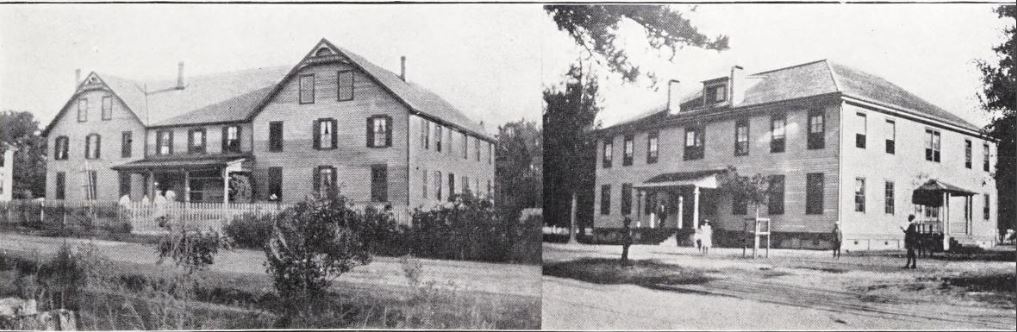
The school transitioned into a center for civil rights in the 20th century. Dr. Martin Luther King, Dr. Ralph Abernathy, Andrew Young, and Dr. Fred Shuttlesworth prepared the March on Birmingham at the school. The school is listed on the National Register of Historic Places and is a featured stop on the U.S. Civil Rights Trail in Georgia.
Golden died in Liberty County, Georgia.
 The Original 33