Robert Lumpkin-Macon County

Robert Lumpkin was born enslaved in Virginia. He lived in Georgia for 50 years, with his last enslaver being Mrs. Phil Cook. After the Civil War, he was freed and elected to the Georgia Assembly from Macon County. Located in South Central Georgia, Macon County is home to Oglethorpe and Andersonville, Georgia, where 13,000 Union soldiers died as prisoners of war during the Civil War. 

Like the other Original 33, Lumpkin was elected in 1868, expelled, and reseated in 1870, but he died of pneumonia one month after being reseated in February 1870.  In that year’s census, his widow’s possessions are listed at $400 in real estate and $432 in personal property. He is buried in a segregated, Black cemetery in Oglethorpe, Georgia. The inscription on his grave reads: “ Hon. Robert Lumpkin, died Feb. 17, 1870. Sail on, Oh ship of state; sail on.” 

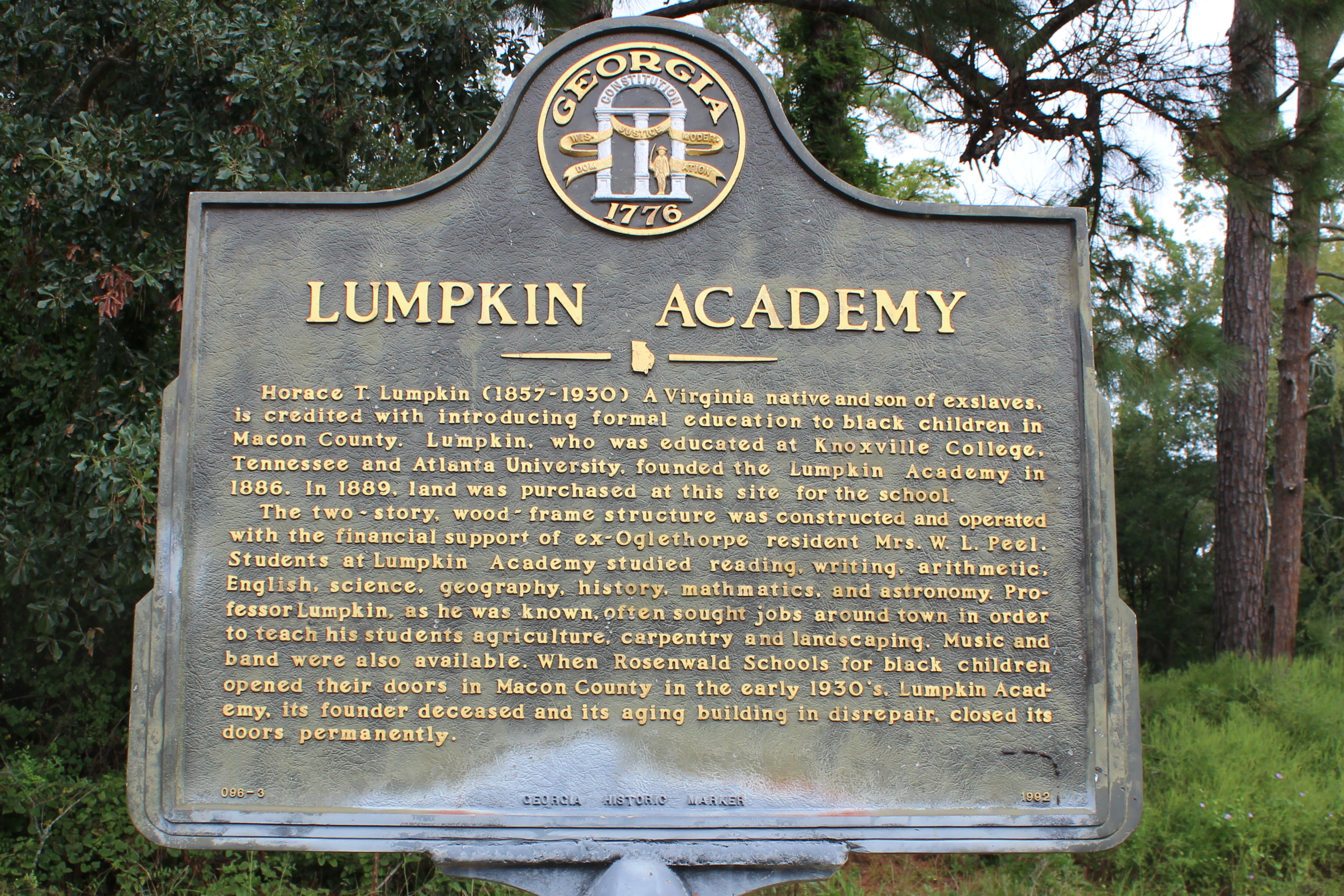
Lumpkin’s son, Horace (1857-1930), was also born into slavery and founded Lumpkin Academy in 1886, the first school for formal education in Macon County for Black students. Horace went to Knoxville College, Tennessee, and Atlanta University. Students at Lumpkin Academy studied reading, writing, arithmetic, English, science, geography, history, mathematics, and astronomy. 

According to the Historical Marker Database: “Professor Lumpkin, as he was known, often sought jobs around town in order to teach his students agriculture, carpentry and landscaping. Music and bands were also available. When Rosenwald Schools for black children opened their doors in Macon County in the early 1930s. Lumpkin Academy, its founder deceased, and its aging building in disrepair closed its doors permanently.” 

Lumpkin Acadamy Historical Marker. See Georgia History.com

Horace Lumpkin’s burial marker reads “Professor H.T Lumpkin, Age Unknown, 8-28-1930.”

REFERENCES:

Foner, Eric. Foner, Eric. Freedom’s Lawmakers. LSU Press, 1996. p 137

Lumpkin Acadamy https://www.hmdb.org/m.asp?m=27258

Robert Lumpkin Sr., U.S. Federal Census Mortality Schedules. https://www.ancestry.com/search/collections/8756/records/405029?tid=&pid=&queryId=c64c4242-1a52-4a7a-b247-6957b50b9e5d&_phsrc=RBh131&_phstart=successSource

Horace Lumpkin, Find A Grave: https://www.findagrave.com/memorial/249443426/horace-t-lumpkin

Philip Joiner-Dougherty County

Philip Joiner (1835-c.1876) was born in Mecklenburg, Virginia, and came to Georgia after being sold in the 1850s. He lived enslaved in Dougherty County prior to the end of the Civil War. Joiner became president of the Union League, a pro-union organization, and was a delegate to the 1867 Georgia Constitutional Convention and an elected representative to the 1868 Georgia Assembly. He represented Dougherty County and lived in Albany, Georgia.

After being expelled from the Assembly, Joiner led a march from Albany, Georgia, to Camilla, Georgia, in protest of the expulsion. Participants in the march were shot at and attacked in Camilla at the Mitchell County Courthouse despite their peaceful intentions when a drunken resident, James Johns, began firing into the bandwagon that accompanied them. A mob began an assault on the marchers, including by the town’s sheriff, who formed a posse to hunt down the freedmen. Joiner was shot in the attack. Joiner testified on the event to the Freedmen’s Bureau as many Black Georgians were killed and wounded in the attack, which is now known as the Camillia Massacre. He also argued that the military had been ineffectual in protecting freedmen and requested that land be set aside in the West for Black settlers. A similar request was made by separatist Georgia Assemblyman Romulus Moore.

Camilla Massacre as depicted in Harper’s Weekly magazine.

In addition to being an assemblyman, Joiner worked as a carpenter and lived in Albany, Georgia, with his wife, Henriette, and their daughters, Mary Jane (5) and Lucy Ann (10), according to the 1870 census. His real estate was valued at $2000, and his occupation was listed as “Representative In Labor Legislator.” His mother, Lucy Parker, also lived with the family.

REFERENCES:

Foner, Eric. Freedom’s Lawmakers. LSU Press, 1996. p 120 

Phillip Joiner https://www.ancestry.com/discoveryui-content/view/185279:8755

Affidavit of Philip Joiner: Albany, Georgia, 1868 Sept. 23 https://dlg.usg.edu/record/dlg_zlcu_cam022?canvas=0&x=1176&y=1619&w=12439

Phillip Joiner, Camilia Race Massacre. Page 176: https://vtext.valdosta.edu/xmlui/bitstream/handle/10428/1130/butler-joshua-w_almost-too-terrible-to-believe_history_thesis_2012.pdf?sequence=1&isAllowed=y 

Lee Formwalt, “Documenting the Origins of African-American Politics in Southwest Georgia,”The Journal of Southwest Georgia History 8 (Fall 1993)

Monday Floyd-Morgan County

Monday Floyd was born into slavery in Greene County in 1809 and worked as a house carpenter after the war. Because enslaved people were not permitted to learn to read and write, Floyd entered the Georgia Assembly, confessing he could read only “a little.” Many legislators derided Floyd and other elected freedmen, such as Eli Barnes, a mechanic, for their lack of literacy and education. Prominent minister and representative Henry M. Turner, scolded their detractors in the Assembly, saying, “These gentlemen do not consider for a moment the dreadful hardships which these people have endured, and especially those who in any way endeavored to acquire an education.”  Turner and other Black Republicans saw Floyd as an example of the need for public education for newly freed Black Georgians, which became a cornerstone mission for many Black politicians. 

Floyd was elected to two terms in the Georgia Assembly. Monday was one of several of the Original 33 that received death threats following their election to public office and their 1870 reinstatement. In 1871 Monday testified before the U.S. Congress on the threats he had received, including a letter from the Ku Klux Klan:

You are requested to resign Your place in the Legislature and retire to private life. We think it the best thing You can do under the present state of affairs. And we hop will comply without further trouble and save us from being provoked to put a dire threat into execution… for we swear by the powers of both Light and Darkness that no other Negro shall ever enter the Legislative Halls of the South. Sir, a word wot the wise is sufficient. Heed, we beseech you, friendly advice, and take warning.  

Haste, O Mondy, to be wise, 

Stay not for the morrow’s sun. 

K.K.K. 

You are requested to resign Your place in the Legislature and retire to private life. We think it the best thing You can do under the present state of affairs. And we hop will comply without further trouble and save us from being provoked to put a dire threat into execution… for we swear by the powers of both Light and Darkness that no other Negro shall ever enter the Legislative Halls of the South. Sir, a word wot the wise is sufficient. Heed, we beseech you, friendly advice, and take warning.  

From Monday Floyd’s testimony about the KKK

In December 1870, Floyd was threatened and shot in his home in Madison, Georgia, by the Ku Klux Klan. The Klan returned 3 days later, and Floyd left Madison for Atlanta. Floyd was not the only legislator to be threatened and attacked in the area. Abram Colby of Greene County was also violently beaten by a group of white men as well as Alfred Richardson, a Black legislator from Clarke County, just north of Greene County. 

REFERENCES:

Drago, Edmund. Black Politicians and Reconstruction in Georgia: A Splendid Failure. UGA Press. 1992. p 38 

Note from KKK in The Making of a Southerner p 93. https://books.google.com/books?id=VCg8T6XBMvwC&pg=PA93#v=onepage&q&f=false 

https://en.wikipedia.org/wiki/Monday_Floyd

US Freedman’s Bureau document. https://drive.google.com/drive/folders/1K-FJBfqVUGT78L_fUoETbE0IeZqEOk3_

Malcolm Claiborne-Burke County

Malcolm Claiborne (sometimes spelled Claiborn) (1838–July 25, 1870) was born in  Lancaster County, South Carolina in 1838. He was elected to the Georgia Assembly representing Burke County along with Black assemblyman John Warren. Claiborne was removed from the legislature in September 1868 and allowed to take office again alongside the other 32 Black representatives in January 1870 after federal intervention. 

Six months after taking his office, Claiborne was shot and killed on July 25, 1870 after a dispute with the messenger sent by the Georgia House, Moses Bentley, after a heated argument over pay of House pages as well as replacing a Black page with a white page. Bentley had been a black delegate of the 1867 Georgia Constitutional Convention.   

Claiborne is believed to be buried in Oakland Cemetery in Atlanta, GA. 

In 2023, Oakland Cemetery featured Malcolm Claiborne in their annual Capturing the Spirit tour.

REFERENCES:
The New York Times (New York, New York) · 1 Aug 1870, Mon · Page 5

Edmund L. Drago (1992). Black Politicians and Reconstruction in Georgia: A Splendid Failure. University of Georgia Press. p. 67.

Foner, Eric (1993). Freedom’s Lawmakers: A Directory of Black Officeholders During Reconstruction. Oxford University Press. p. 46

Davis, Ren; Davis, Helen (2012). Atlanta’s Oakland Cemetery: An Illustrated History and Guide. University of Georgia Press. p. 158

Madison Davis-Clarke County

Madison “Matt” or “Mat” Davis was born into slavery on September 27, 1833 in Athens, Georgia. His enslaver was a local carriage maker and he gained his freedom after the Civil War at the age of 33. Davis became Captain of Relief No. 2 in 1866, which was Clarke County’s first black fire company.

Davis was also part of the land purchase for the Knox Institute and Industrial School, which was a private elementary and secondary school for Black Georgians in Athens from 1868-1928.

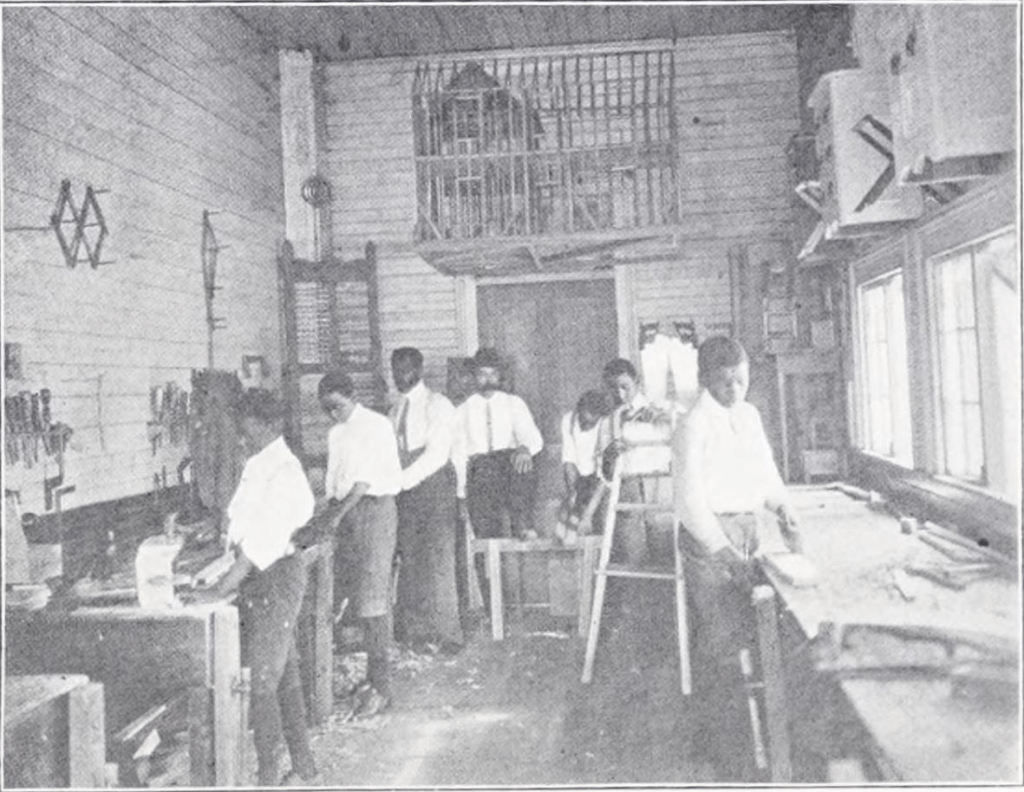
Carpentry Class at Knox Insitute. An Era of Progress and Promise, 1863–1910: The Religious, Moral, and Educational Development of the American Negro Since His Emancipation, p. 149

Davis was elected to represent Clarke County in the Georgia Assembly in 1868 and was reinstated in 1870 following federal intervention on behalf of the Original 33 lawmakers unlawfully removed from the House of Representatives. Davis won back his seat in 1870 and introduced several bills including building a new Georgia Railroad line through the city of Athens. David did not run for reelection in 1872 instead pursuing a career in real estate. He continued to remain active in the Republican party and was appointed Postmaster of Athens by President Harrison in 1890.

Davis continued to live in Athens, GA with his wife Ella and their children on Newton Street. They were married for 44 years. Madison Davis died on August 20, 1902. He is buried in Gospel Pilgrim Cemetery in Athens.

REFERENCES:

“27 September 1833: Legislator Madison Davis Is Born.” This Day In Athens. Athens-Clarke County Library Heritage Room. September 27, 2010. http://accheritage.blogspot.com/2010/09/27-september-1833-legislator-madison.html?m=1

https://www.findagrave.com/memorial/103060294/madison-davis

https://en.wikipedia.org/wiki/Madison_Davis

Hester, Albert Lee (2010). Enduring Legacy: Clarke County Georgia’s Ex-Slave Legislators Madison Davis and Alfred Richardson. Athens, GA: Green Berry Press.

John Warren – Burke County

John Warren was elected as representative from Burke County, which is located south of Augusta on the border with South Carolina. Little is known now of Warren beyond his election to the Georgia Assembly. On January 18, 1870, The Georgia Weekly Telegraph, Journal and Messenger reported that although reinstated, Warren did not appear at the House of Representatives to be sworn in on January 10th. In 1874 Warren was listed as owning 40 acres of land with an estimated worth of $300.

Below is a “report of assaults with intent to murder, committed upon freed people in the division of Albany from January 1st to October 31st 1868.”

REFERENCES:

“The House of Representatives.” The Georgia Weekly Telegraph, Journal and Messenger  January 18, 1870. p. 1.

Forner, Freedom’s Lawmakers, p.223.

The Freedman’s Bureau Online. https://www.freedmensbureau.com/georgia/gaoutr8.htm

John T. Costin-Talbot County

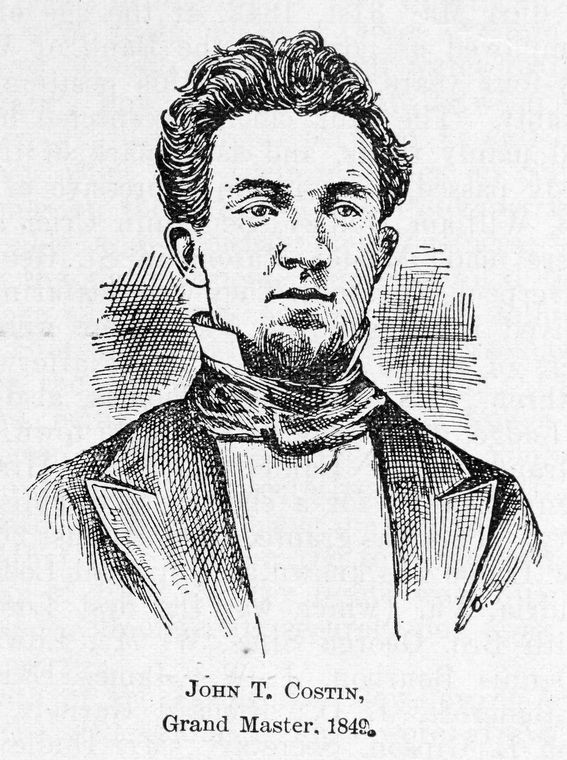
John T. Costin was born in Virginia (East Washington, DC) around 1828. He was a Freemason and Grand Master of a Black Masonic Lodge in the District of Columbia in the late 1840s. After the Civil War, he came to Georgia as a Republican Party organizer. Costin was a barber, preacher and A.M.E Zion minister, and active member of Black Freemasonry. His father had been involved in assisting runaway slaves prior to the Civil War, and despite threats of physical violence in Georgia, Costin persisted, traveling throughout the state to tell people their rights as free men and women. In a letter back to D.C., Costin wrote:

On my return I stopped at another town called Red Hills, where I performed the same duty and organized clubs in each. I arrived in Waynesboro Friday evening. Our mass meeting was largely attended, all classes being present. To my surprise, I was offered the use of the Court House, but in consequence of the excessive heat and the large number of people, we took the grove. There were people at the meeting from a distance of 25 miles. It was a great success. Everything went off peaceable and pleasant. The freedmen declared it to be the first time since their emancipation that they had ever had explained to them their rights before the law. The rebs. cursed me terribly, some threatening to shoot me, but the only thing that occurred was being spit upon by a rebel while passing the street. I took no notice of the insult, because they were nearly 2000 colored persons in the place and nearly every one had fire-arms.

As a Republican Party organizer, civil rights leader, and political activist, Costin earned the support of many Black voters. He was elected to represent Talbot County in the Georgia Constitutional Convention of 1867/68 and in the Georgia Assembly. Just before election day 1868. Just before Election Day 1868, the KKK threatened Costin with physical violence, and he was forced to leave Talbot County. Nonetheless, Costin was elected and reinstated to the State Legislature in January 1870.

The rebs. cursed me terribly, some threatening to shoot me, but the only thing that occurred was being spit upon by a rebel while passing the street. I took no notice of the insult, because they were nearly 2000 colored persons in the place and nearly every one had fire-arms.

From a letter that Costin sent back to DC

According to the 1870 census, John lived in Washington DC with his wife Elizabeth and their children Virginia (17), Harriet (14), John T (12), Annie (10), and Owen (6.) His occupation was listed as a barber. By 1880 the family was still living in Washington DC. Virginia and her husband William Wilkes, a fireman, were living with the family as well as John T., now 21 and working as a store clerk; Anna, who was at the Normal School; and Owen, who was also in school. Harriet, listed as a servant, was also living with the family.

John T. Costin passed away at the age of 60 at his home in Washington, DC on February 28, 1888. He is buried at Harmony Cemetery in Washington, DC.

James Ward Porter-Chatham County

Born free in 1828 in Charleston, SC, to Martha Porter, James Ward Porter established a secret school for Black education before the Civil War. He came to Savannah in 1856 as a music director for an A.M.E church and established a music school where he gave lessons to both black and white students while also working as a tailor. Porter also kept a secret school for educating Black pupils, many of whom did their studies in the privacy of their homes. In 1865 Porter opened a school and published English Language for Beginners. He also preached at the Savannah Protestant Episcopal Church. James Ward Porter was elected a state representative in Georgia, representing Chatham County along with fellow Black assemblyman James M. Sims. Porter was the owner of a tailor’s shop in Savannah and was the wealthiest Black political leader in the state. He married Elizabeth. In the 1870 census, he is listed as owning $3,000 in real estate and $400 in personal property and living in Savannah with 4 children: John A. (15), Laura F. (13), James R.(11), Elizabeth M.(7.) In the 1870s Porter led a campaign against the segregation of Savannah streetcars and worked as an inspector of customers in Savannah. He was the first Black principal in Thomasville, GA, and a school principal in Yazoo, Mississippi.

James Merilus Simms-Chatham County

James Merilus Simms was born December 27, 1823, and enslaved at James Potter’s Coleraine Plantation, located upriver from Savannah, Georgia. It’s implied that he was the son of his enslaver, and learned to read and write from the tutor that Potter hired for his white children. In 1857, either Sims or his mother (accounts vary) purchased his freedom. He was baptized into the First African Baptist Church of Savannah, later expelled for lack of humility, and returned in 1858. By 1860, Sims had become an ordained minister and was operating a school for Black children in Savannah. Only six schools of this kind existed in antebellum Savannah, as educating Black people was considered a crime. Simms was the only teacher punished for this crime and was sentenced to a fine of $50 and fifteen lashes. Shortly thereafter, he moved to Boston, Massachusetts, where his younger brother had moved after escaping enslavement in 1851.

Simms joined the Union Army, serving as chaplain during the Civil War, and by the spring of 1865, he was back in Savannah. In 1867, he established the Southern Radical and Freedman’s Journal (later renamed the Freeman’s Standard). He also worked for the Freedmen’s Bureau and was a Union League organizer. Sims was one of the ministers to sign a petition protesting the treatment of Black soldiers in the Union Army and was an ardent supporter of voting rights.

He wrote The First Colored Baptist Church in North America, which entailed the history of First Bryan Baptist Church, and he is credited with establishing the first Prince Hall Masonic Lodge in Georgia. Simms was elected to the Georgia House of Representatives in 1868. After being expelled, he was reinstated in 1870 but subsequently lost re-election.

The photo of the second church that was built in 1873 and is still used today.

In one of Governor Rufus Bullock‘s last acts before he left office, he appointed James Simms, district judge of the First Senatorial District sitting in Savannah, the first Black judge in Georgia. New Democratic legislators moved the court out of the district. Afterward, Simms received a federal appointment as inspector at the U.S. Customs House in Savannah. He remained active as a senior statesman in the city’s African-American community until his death on July 9, 1912. The Most Worshipful Prince Hall Grand Lodge of Georgia placed a monument over Simms’ grave in Laurel Grove South Cemetery in June 1920.