Bishop Henry McNeal Turner-Bibb County

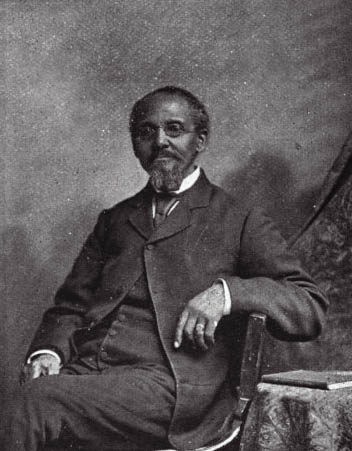
Henry McNeal Turner (February 1, 1834 – May 8, 1915) was born free in 1834 in Newberry, South Carolina, to Sarah Greer and Hardy Turner, who were of mixed African-European ancestry. His paternal grandparents were a white woman planter and an African man, who was rumored to be an African prince. According to slave law in the colony, the white woman’s mixed-race children were born free because she was white and free.

At the age of 14, Turner was inspired by a Methodist revival and decided to become a pastor. After earning his pastorate license, Turner traveled the South preaching about the Methodist faith. In 1856, he married Eliza Peacher, the daughter of a wealthy Black contractor from Columbia, South Carolina. In 1858, he moved his family to Saint Louis, Missouri, to escape the possible kidnapping of his family by ruthless slave catchers who received bounties for catching escaped slaves. Slave catchers often rounded up free Black men, women, and children because it required little to no documentation to prove that someone was enslaved.

While in St. Louis, Turner was ordained as a minister in the African Methodist Episcopal (AME) church, the first Black Christian denomination in the United States. Turner moved his family to the Washington, DC area to serve area AME churches. It is here where he developed ties with different politicians who would often hear him preach at the area churches. 

During the Civil War, Turner helped organize Company B of the United States Colored Troops (UCST) and served as their chaplain. During this time period, his reputation as spokesman and leader spread throughout the USCT and eventually throughout the country. His writings about the experience of the USCT are considered some of the best information about the UCST experience in the Civil War. Additionally, his work helped spread the word about the AME Church. Turner was appointed to work with the Freedmen’s Bureau during Reconstruction. 

After the Civil War, Turner helped found the Republican Party of Georgia. Turner ran to be a representative in the Georgia legislature in 1868 and was elected to this position. He represented Bibb County. In 1869, he was appointed to serve as postmaster for Macon. 

In 1883, the United States Supreme Court ruled that the Civil Rights Act of 1875, which forbid racial discrimination in public places, such as hotels and trains, was ruled unconstitutional. Turner, who felt the federal government had failed in its support of the Black community, especially in the South, began to support the emigration of Black people to Africa. He founded the International Migration Society. He organized to send 500 people on two ships to the country of Liberia, which had been founded as an American colony prior to the Civil War and was settled by free American Black men and women. 

During the 1870s to 1880s, he served as president of Morris Brown College for twelve years starting in 1876. Turner was elected as the twelfth bishop of the AME Church in 1870. He was the first one to be from the South.

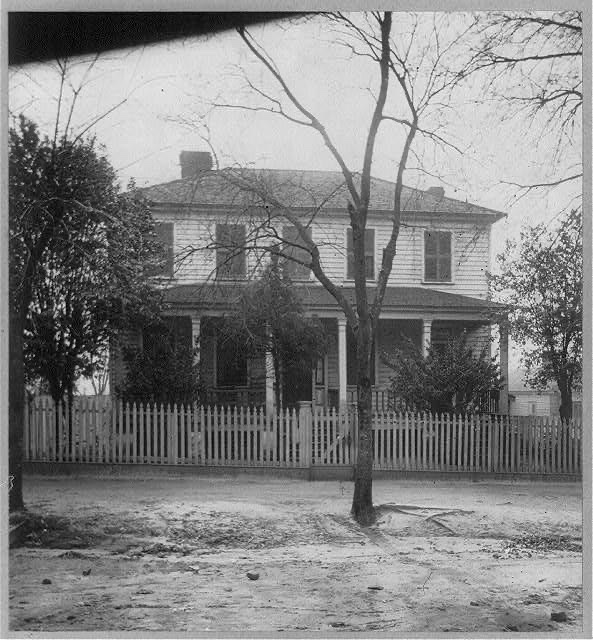
Turner’s home in 1899 Atlanta

Turner died in 1915 while visiting Windsor, Ontario, to attend an AME Conference. He is buried at South-View Cemetery in Atlanta.

He outlived three out of his four wives. In addition to Peacher, he married Martha Elizabeth DeWitt, Harriet Wayman, and Laura Pearl Lemon. He had fourteen children. Only four of his children lived to adulthood. They were Lincolnia Victoria King, Josephine Upshaw, John Turner, and David Turner.

George Wallace-20th District

Born around 1840, George Wallace was a native of Georgia and represented District 20 (Hancock, Baldwin and Washington counties) in middle Georgia in the1868 Georgia Assembly and in the Georgia State Constitutional Convention of 1867-68. Wallace was biracial and was one of the first three Black senators elected in Georgia, the other being Tunis Campbell Sr. Unseated with the other Black members, Wallace was restored to his senate seat in 1870 by an Act of Congress.  Wallace served on the Republican state committee in 1868, attended the 1869 Georgia labor convention, and was a delegate to the Republican national convention of 1876. According to the 1870 census, Wallace owned $100 in personal property. 

In addition to serving in the Georgia Assembly, Wallace was a founder of the Macon Union League, an organization that demonstrated unwavering support for the Union and was active in the Georgia Educational Association. He represented District 20 in the Georgia State Constitutional Convention, which was the first constitutional convention to include Black delegates and was held in Atlanta. During the convention, Wallace was an outspoken critic of the proposed move of the capital from Milledgeville to Atlanta. As a representative of District 20, which Milledgeville, Wallace proposed putting the move to a state-wide vote. Ironically, the reason the convention was moved from Milledgeville to Atlanta in 1867-1868 was because Milledgeville’s innkeepers refused to allow the Black delegates room and board for the state constitutional convention. Without lodging in Milledgeville for all delegates, US Army General John Pope ordered the convention to be held in Atlanta. The Capital was permanently moved from Milledgeville to Atlanta in 1877. 

George Linder-Laurens County

George Linder was born in 1834 in Laurens County, Georgia. While still enslaved, he founded Strawberry AME Church (pictured above) in 1859. At the conclusion of the Civil War, he attended the 1868 Georgia Constitutional Convention held in Atlanta. He represented the Sixteenth Election District. The convention lasted from December 1867 to March 1868. Required by the federal government, the convention created the new Georgia state constitution. Linder was elected to be a state representative. After being expelled, Linder was quoted saying, “Roust us from here, and we will roust you!”

In addition to being an AME pastor, Linder helped found two other AME churches in Laurens County. He was a successful farmer owning several hundred acres in the Buckeye District, just outside of Dublin, Georgia. He and his first wife, Peggy, had seven children. He had an additional ten children with his second wife, Mary. At some point, Linder moved his family from the farm into Dublin. The Linder family home still stands today.

George Clower-Monroe County

George Clower was born around 1831 in Virginia and became a leader in the Republican Party in Monroe County, GA after the Civil War. He attended the Colored Educational Convention in Macon, the state Black convention of 1866, and was elected to the Georgia Assembly in 1868. Clower also worked as a school teacher during Reconstruction and as a voter organizer in Monroe County. Clower noticed that Blacks were being terminated from their white employers after voting Republican, and he worked with Union General John R. Lewis of the Freedmen’s Bureau to end white retaliation against Black voters. 

Clower organized “Grant Clubs” in support of former Union general Ulysses S. Grant as he ran for President. Many of these club organizers faced significant white retaliation and physical violence. A Black organizer in Dooly County, Georgia went into hiding after threats on his life, publishing an article in Augusta’s The National Republican arguing that “I have not been charged with any crime for which forty or fifty men should be after me, but simply a Republican, wanting to see the liberties of my race secured. These armed men are Democrats, sworn to kill me and all men getting up these clubs; some of them are officers of the law, Judges of the Courts, and Sheriffs. They are persecuting us under the name of keeping order and suppressing insurrections among my race.”  After the Dooly County club met outside Vienna, their meeting location was surrounded, and the president was arrested by white leaders in the town. 

Clower himself appealed to U.S. Grant for support, both political and financial. In a June 1872 letter to Grant supporting his election, he wrote: 

“We must Go to Work right now if We Expecte to Beate the Democrats party. Dear president if you Will help me I Will go to Work Wit away no man of my Colard can do more Good for the party than I Can… I am very poor and are not abel to do much for the party the Democrate party have offar me $5000.00 and told me I can get ten $1000.00 if I Will Go in to the Feald and Go to Work for them But I am republican Expect to Live and die one. I am a Member of the Legislature and have been for 4 years. Dear sir if you Will let me have some Money I Will do as much Good to organized as a man in the sate I am also a member of the state sentral Committe. Dear sir pleas Help. me if you can right away and I Will Go to Work for the presedenal Campe Pain   please let me here form you soon  Excuse bad Writing as I am a colard man.” 

In the 1870 census, Clower is listed as owning $1000 in real estate and $500 in personal property. He was living in Forsyth with his wife, Sarah, and their six children: Ned (15), Rosaina (12), Lucinde (11),  George (8), Sarah J. (4), Payton 2. Clower became an A.M.E minister living in Memphis, TN in his later years. 10 years later in the 1880 Census, he is listed as a Preacher living in Memphis with Sarah, and their children Rosanna, Lucinda, George H, Eliza, Payton, and John. 

While it is unclear where George Clower is buried, it is likely that he passed away in Memphis. Ned Frances and Payton Clowers are both buried along with Ned’s daughter at Whites Chapel Cemetery in Memphis.  

Francis H. Fyall-Macon County

Francis Henry Fyall was one of 29 African American men that made up the House of Representatives of the General Assembly of Georgia, which first met on July 4, 1868. Twenty-five of these men were identifiable as Black, per the color of their skin, but four were racially ambiguous. Fyall was one of those four.

The first method of attack by hostile white legislators was to question each representative’s eligibility to serve the county. For Fyall, claims were made that he was a resident of Macon, Georgia, which was located in Bibb County, and not an actual resident of Macon County. In later testimony, Fyall explained that he had made a home in Macon County but was run out with threats of violence against him and his wife.

The second method of attack was to question Fyall’s race. By law, the white legislators had determined Black men ineligible to hold office. Twenty-five men were immediately removed, and a committee of five white men was formed to decide the fate of the four racially ambiguous. Fyall is called to testify, and he described his upbringing; the child of two white, Charleston French parents, his mother died when he was 6 years old. Another witness was brought to the stand and described Fyall’s mother as a mulatto woman and expressed he could find 100 more witnesses who would attest to the same. It was also described in the proceedings that Fyall was sold as a slave to a Mr. Habersham of Savannah, later enslaved by Dr. M.S. Thompson, and last, the property of Judge O.A. Lochrane.

They gave their determination on September 15th, stating: “they find the said F. H. Fyall to have more than one-eighth negro blood in his veins, and in accordance with the action of this House declaring the ineligibility of negroes to hold office under the Constitution of this State, respectfully offer the Following: Resolved, That F. H. Fyall is ineligible, under the Constitution, to a seat as a member of this body, and after the passage of this resolution, that his name be dropped from the roll.”

On September 18th, F.H. Fyall presented a motion, with the support of 14 white senators, 20 white Republicans, and 28 African American representatives, titled the “Memorial to the Members of the Legislature of Georgia and Others, Relative to the Illegal Organization of that Body Under the Reconstruction Acts.” The action did almost nothing to deter his fate of expulsion.

By April of 1869, he was put on trial for perjury, related to the false swearing that he lived in Macon County. That case was short-lived, as his claim was made orally and not written. Georgia Governor Rufus Bullock promoted Fyall to train hand on freight trains for the Western and Atlantic Railroad. In September of 1869, while traveling through a rock culvert at the crossing of East Tennessee and Georgia Railroad, he was knocked on the head by the culvert and killed. His corpse was sent “down the state road,” but information about his burial site has not been found.

Eli Barnes-Hancock County

Eli Barnes was elected as a representative to the Georgia Assembly as a Republican to represent Hancock County, Georgia. Unlike several of the Original 33, there is no Freedman’s Bureau Record to collect basic family information, so there is little known about Barnes. He testified to Congress about harassment and intimidation of Black people at the hands of the Ku Klux Klan. He told the congressional investigating committee, “It has got to be quite a common thing. . . to hear a man say, ‘They rode around my house last night, and they played the mischief there; my wife was molested, my daughter badly treated, and they played the wild generally with my family.’”

It has got to be quite a common thing. . . to hear a man say, ‘They rode around my house last night, and they played the mischief there; my wife was molested, my daughter badly treated, and they played the wild generally with my family.’

Condition of the Affairs of the Southern States testimony

Edwin Belcher-Wilkes County

Edwin Belcher was born on July 31, 1845 to his father and his slave enslaver, Robert E. Belcher and an unknown enslaved woman near Abbeville, SC. In an 1873 letter to abolitionist leader William Lloyd Garrison, Belcher wrote briefly of his parentage and early upbringing: “I am a Colored man, was born the Slave of my father in South Carolina in 1845. At an early age through the exertions of my mother I was sent to the North where I was attending school when the war Commenced in 1861.” At the start of the war, Belcher was just 16 years old, living in Philadelphia, PA and attending the all-white Pennsylvania High-School. He immediately enlisted the Union Army, leaving school to fight for the United States.

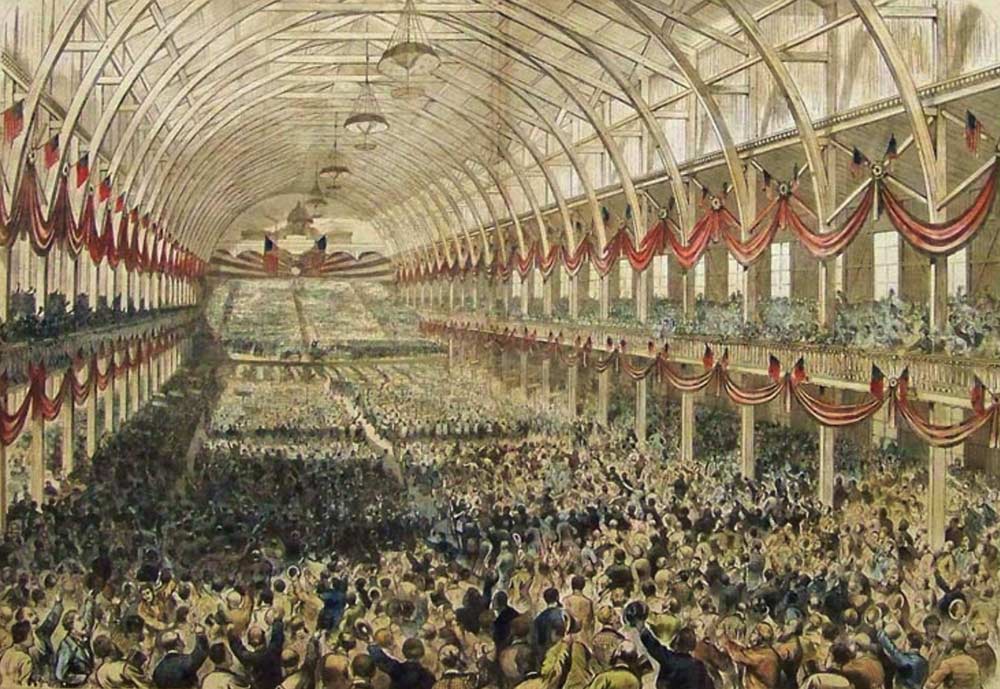
Belcher attended the 1876 Republican National Convention.

Because of his light complexion Belcher could pass for white. He rose through the ranks of the Union Army to a command position. When whites in Georgia learned he was Black he responded “My blood has dyed the soil of the Sunny South as deep as any other soldiers… My service during the war was just as acceptable as any other man’s and  was appreciated.” During the Civil War, Belcher was both imprisoned in a Confederate camp and suffered a blow to the skill which caused him to have seizures for the rest of his life. Belcher engaged in several battles during the Civil War, his last engagement was in Atlanta during Sherman’s March to the Sea. His father, Robert, rose to the rank of Colonel in the Confederate Army and commanded a Confederate regiment.   

After the Civil War, Belcher held several key positions for the U.S. Government and in Georgia politics. He was a revenue tax officer in Augusta, a Wilkes County representative for the 1868 Georgia Legislature and a member of the Georgia Constitutional Convention, also representing Wilkes County. Belcher was not expelled with his other colleagues in 1868 because he was so light skinned. In 1872, Belcher graduated from Howard University Law School (founded in 1868) and was one of the first graduates of Howard Law. He was admitted to the Washington D.C. bar following graduation. (His brother Eugene R. Belcher was also an early graduate of Howard University Law School.) Edwin Belcher also served as Macon, GA Postmaster and was working as a route agent between Atlanta and Augusta at the time of his death. Edwin Belcher married Ida and they had a 9-month infant named William S. Belcher (who would later go by Sumner) at the time of the 1870 census. 

Belcher died in Augusta, Georgia on January 7, 1883 at the age of 37 after a two-month long illness caused by typhoid-pneumonia. A special dispatch to the Chicago Tribune written in Atlanta, Georgia published Belcher’s obituary describing him as “without exception he was the most powerful debater and stump-speaker of his race in this section and probably in the South. His appearance was commanding, and his reputation as an orator was such like that of Bob Toombs, he never spoke to an empty seat.” Edwin Belcher’s death received national attention. News of his passing was published in the Chicago Tribune, The St. Louis Post-Dispatch, The St. Louis Globe-Democrat, Lewiston, Maine’s Sun-Journal, The Dayton Herald, The Savannah Morning News, and The Daily Chronicle of Knoxville, Tennessee. The Atlanta-based author concluded Belcher’s obituary saying, “His mother resides here.” Edwin Belcher is buried at Arlington National Cemetery in Arlington, Virginia.

Alfred Richardson-Clarke County

Richardson (c1837–1872) was enslaved and post-Civil War, worked as a carpenter and owned a tavern. He was elected to the Georgia Assembly representing Clarke County. Richardson survived two Ku Klux Klan attacks in the same month on his home in Watkinsville. In 1872 Richardson testified to a congressional committee that it was not safe for him to go home, so he was staying in Athens, Georgia. He was reinstated in 1870 and served in the Assembly until his death from pneumonia in 1872.