Eli Barnes was elected as a representative to the GeorgiaAssembly as a Republican to represent Hancock County, Georgia. Unlike several of the Original 33, there is no Freedman’s Bureau Record to collect basic family information, so there is little known about Barnes.He testified to Congress about harassment and intimidation of Black people at the hands of the Ku Klux Klan. He told the congressional investigating committee, “It has got to be quite a common thing. . . to hear a man say, ‘They rode around my house last night, and they played the mischief there; my wife was molested, my daughter badly treated, and they played the wild generally with my family.’”
It has got to be quite a common thing. . . to hear a man say, ‘They rode around my house last night, and they played the mischief there; my wife was molested, my daughter badly treated, and they played the wild generally with my family.’
Condition of the Affairs of the Southern States testimony
Edwin Belcher was born on July 31, 1845 to his father and his slave enslaver, Robert E. Belcher and an unknown enslaved woman near Abbeville, SC. In an 1873 letter to abolitionist leader William Lloyd Garrison, Belcher wrote briefly of his parentage and early upbringing: “I am a Colored man, was born the Slave of my father in South Carolina in 1845. At an early age through the exertions of my mother I was sent to the North where I was attending school when the war Commenced in 1861.” At the start of the war, Belcher was just 16 years old, living in Philadelphia, PA and attending the all-white Pennsylvania High-School. He immediately enlisted the Union Army, leaving school to fight for the United States.
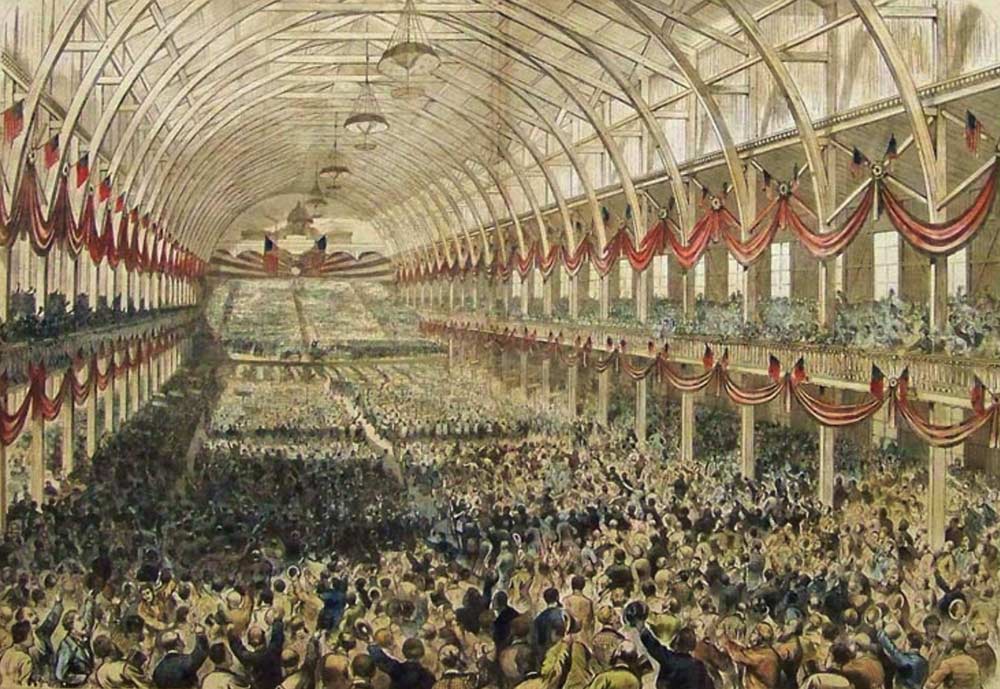
Belcher attended the 1876 Republican National Convention.
Because of his light complexion Belcher could pass for white. He rose through the ranks of the Union Army to a command position. When whites in Georgia learned he was Black he responded “My blood has dyed the soil of the Sunny South as deep as any other soldiers… My service during the war was just as acceptable as any other man’s and was appreciated.” During the Civil War, Belcher was both imprisoned in a Confederate camp and suffered a blow to the skill which caused him to have seizures for the rest of his life. Belcher engaged in several battles during the Civil War, his last engagement was in Atlanta during Sherman’s March to the Sea. His father, Robert, rose to the rank of Colonel in the Confederate Army and commanded a Confederate regiment.
After the Civil War, Belcher held several key positions for the U.S. Government and in Georgia politics. He was a revenue tax officer in Augusta, a Wilkes County representative for the 1868 Georgia Legislature and a member of the Georgia Constitutional Convention, also representing Wilkes County. Belcher was not expelled with his other colleagues in 1868 because he was so light skinned. In 1872, Belcher graduated from Howard University Law School (founded in 1868) and was one of the first graduates of Howard Law. He was admitted to the Washington D.C. bar following graduation. (His brother Eugene R. Belcher was also an early graduate of Howard University Law School.) Edwin Belcher also served as Macon, GA Postmaster and was working as a route agent between Atlanta and Augusta at the time of his death. Edwin Belcher married Ida and they had a 9-month infant named William S. Belcher (who would later go by Sumner) at the time of the 1870 census.
Belcher died in Augusta, Georgia on January 7, 1883 at the age of 37 after a two-month long illness caused by typhoid-pneumonia. A special dispatch to the Chicago Tribune written in Atlanta, Georgia published Belcher’s obituary describing him as “without exception he was the most powerful debater and stump-speaker of his race in this section and probably in the South. His appearance was commanding, and his reputation as an orator was such like that of Bob Toombs, he never spoke to an empty seat.” Edwin Belcher’s death received national attention. News of his passing was published in the Chicago Tribune, The St. Louis Post-Dispatch, The St. Louis Globe-Democrat, Lewiston, Maine’s Sun-Journal, The Dayton Herald, The Savannah Morning News, and The Daily Chronicle of Knoxville, Tennessee. The Atlanta-based author concluded Belcher’s obituary saying, “His mother resides here.” Edwin Belcher is buried at Arlington National Cemetery in Arlington, Virginia.
Stone was a member of Georgia’s constitutional convention held in 1867 and 1868, and elected to the Georgia Legislature in 1868. He was reinstated in 1870 and the census shows he was living with his wife America and their two children.
Abraham Smith was a minister and native of Georgia. He was elected to the House of Representatives from Muscogee County, home to Columbus, Georgia. Smith served as Vice President of the Georgia Labor Convention held in Macon in October 1869, which was attended by fellow Original 33 member, Senator George Wallace. The convention received national attention and a write-up in the August 19 New York Times. Its aim was to discuss ideas and plans to create organized systems of Black labor with the aim of helping Black workers advance in Reconstruction Era Georgia amid the influx of workers coming to the State.
Aaron Alpeoria Bradley (c. 1815–1881) was a lawyer and civil rights activist in the United States. He was born into slavery on a Plantation in South Carolina around 1815 and was of mixed ethnicity. He escaped slavery, went North, and became a lawyer in Massachusetts in 1856. He was the third African American admitted to the Massachusetts Bar. At the end of the Civil War, Bradley moved to Savannah in 1865. He applied for the Georgia Bar but was denied admittance due to his race and controversial political activism against racial injustice. He became a lawyer in neighboring South Carolina and continued to practice law in Georgia without a license until 1875.
Bradley was elected as a representative to Georgia’s Constitutional Convention of 1867/68 and to the Georgia Assembly as one of 3 Senators. He represented District 1, which covered Chatham, Bryan and Effingham counties.
Bradley was a powerful orator and outspoken civil rights activist. He believed in the freedom of the Black race and championed all black causes. He is accredited as an early proponent of what would become the Black Power Movement, often calling for liberation and escalation of Black Americans in his speeches. He was also an anti-capitalist and held beliefs that predated the Populist Movement decades later. Bradley also pushed on shared social issues like the Homestead Acts, labor reform, end to debtors’ prison, which banded poor whites with many Black Georgians and fueled hatred among many white Georgians.
Peter O’Neal was born around 1813. He attended the Georgia Educational Convention in Macon in May of 1867 along with many of his fellow future Assemblymen. He was elected to the Georgia House of Representatives in his mid 50s representing Baldwin County, home to Milledgeville, the capital of Georgia. In his time in the Assembly, he championed a bill to abolish the penitentiary system and another ensuring payment of wages due to agricultural laborers, most of whom were newly freed Black Georgians.
O’Neal continued to be a champion of labor rights for agricultural workers in the state beyond his time in the Assembly. In May 1887, a then elderly O’Neal hosted Hiram Hoover, a white Texan labor organizer, at his home in Milledgeville. Hoover gave two speeches to hundreds of Black agriculture workers, encouraging listeners to strike for a wage of $1.50, triple their customary compensation, and that they should organize. He issued a charter for his integrated union, Cooperative Workingmen, in Milledgeville and charged dues of 55 cents per person.
The local newspaper (and others throughout the country) picked up the story reporting Hiram Hoover was inciting violence among Black laborers and urging them to demand higher wages and “if what they demanded was not given then to use the torch to the white man’s house.” Whites retaliated against O’Neal, F.F. Boddie (a minister in the African Methodist Church) and Hoover. Hoover was shot while giving a speech at the black Methodist church on the outskirts of Milledgeville by several robed masked men who escaped on horseback and were never arrested. Hoover survived, but according to the June 2, 1887, Kansas Great Bend Register, the right side of his face was badly injured, and he lost an eye. No doctor in the vicinity would treat him.
On May 28, 1887, O’Neal and his family were preparing to move to Macon when a fire was set on their home. Mrs. O’Neal barely escaped.
At the time of the 1870 Census, O’Neal owned 300 in real estate and 100 in personal property. He was 57 and married to Mildred O’Neal, also 57, and they had two children living with them: Peter O’Neal, then 20, and Joel O’Neal, 17. His occupation is listed as “Rep. In Legislature.”
A group of researchers will be delving into newspaper archives, census records, and anything else that can be found on The Original 33. For some of the men, their stories will be much easier to tell. For others, the information is limited. However, their lives must be shared with others, no matter how great or little information can be found. Stay tuned as the biographies are developed and shared here.
A Fundly site has been set up to fundraise to cover the costs of research and events.
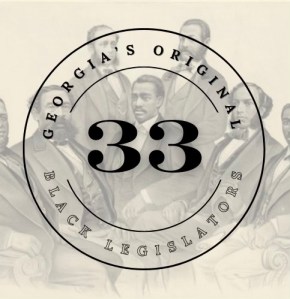
The Original 33 were the first Black legislators elected in Georgia during Reconstruction. Elected in 1868 to the Georgia General Assembly, the men were forcibly expelled from office when white Democrats conspired with some white Republicans to have them removed.
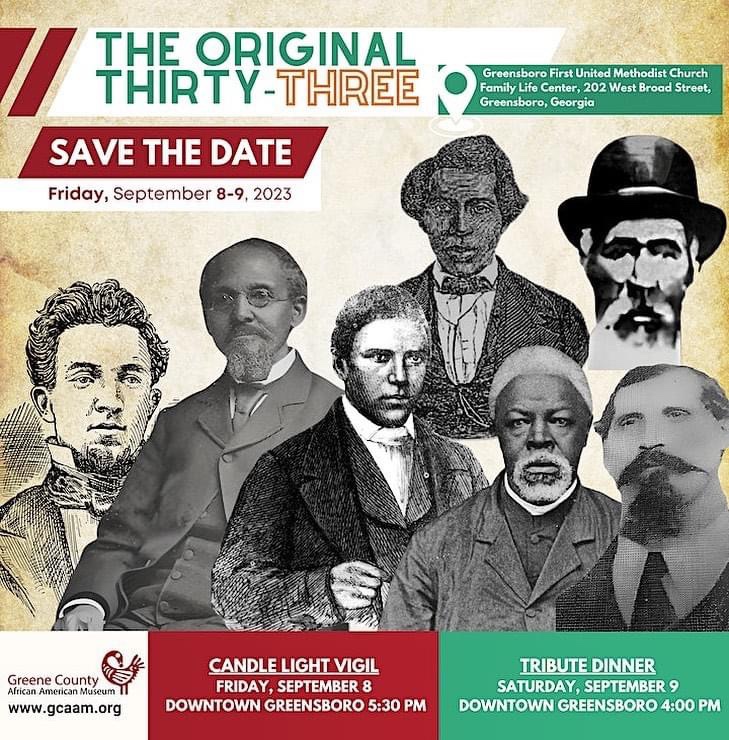
Join us in Greensboro for a Candle Light Vigil on Friday, September 8, 2023 and a dinner on Saturday, September 9, 2023. Tickets for the dinner can be purchased online.


 The Original 33