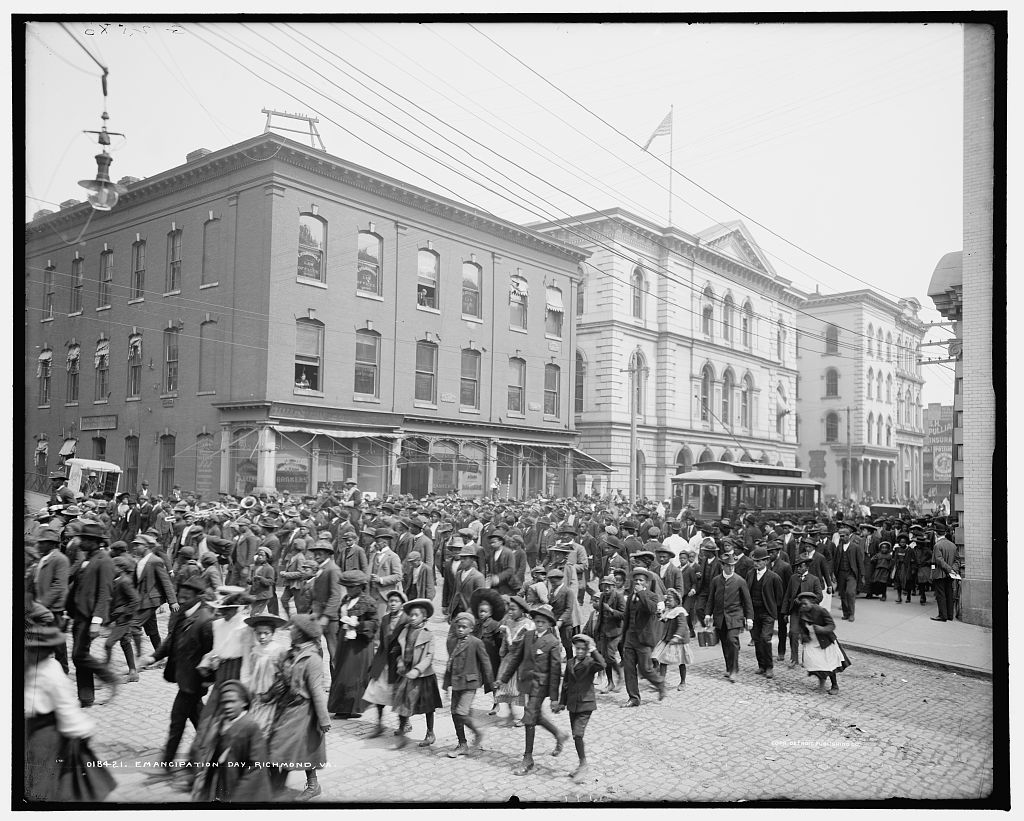
William A. Guilford (February 5, 1844 – October 1909) was a barber and state legislator from Upson County, Georgia. Guilford was a representative of Georgia’s constitutional congress in 1868 and was an elected representative in Georgia’s assembly during the 1868–1870 term. A Republican, he helped found the Republican Party in Upson County. He organized the Upson County’s Emancipation Celebration, which still occurs on or near May 19th.
Emancipation Day celebration in Richmond, Virginia. Image courtesy of the Library of Congress.
William Guilford’s father, Guilford Speer, operated a harness and shoe shop in Thomaston, dating back to the 1840s. Guilford was also a founding organizer of St. Mary’s A.M.E. Church. Guilford and his wife, Lourinda, had at least 8 children including William (who died before 1870), Guilford, Duffield, Lincoln, Douglass, Richard, Ludie, Benjamin, and Lidie (Lydia). He owned 12 acres of land in Thomaston, Georgia. Guilford was one of several witnesses on behalf of political activist William Fincher of Pike County, who was accused of vagrancy in 1868. The case was submitted to the U.S. Congress as an example of a violation of Civil Rights. The jury sentenced Fincher to a year of hard labor on the public roads.
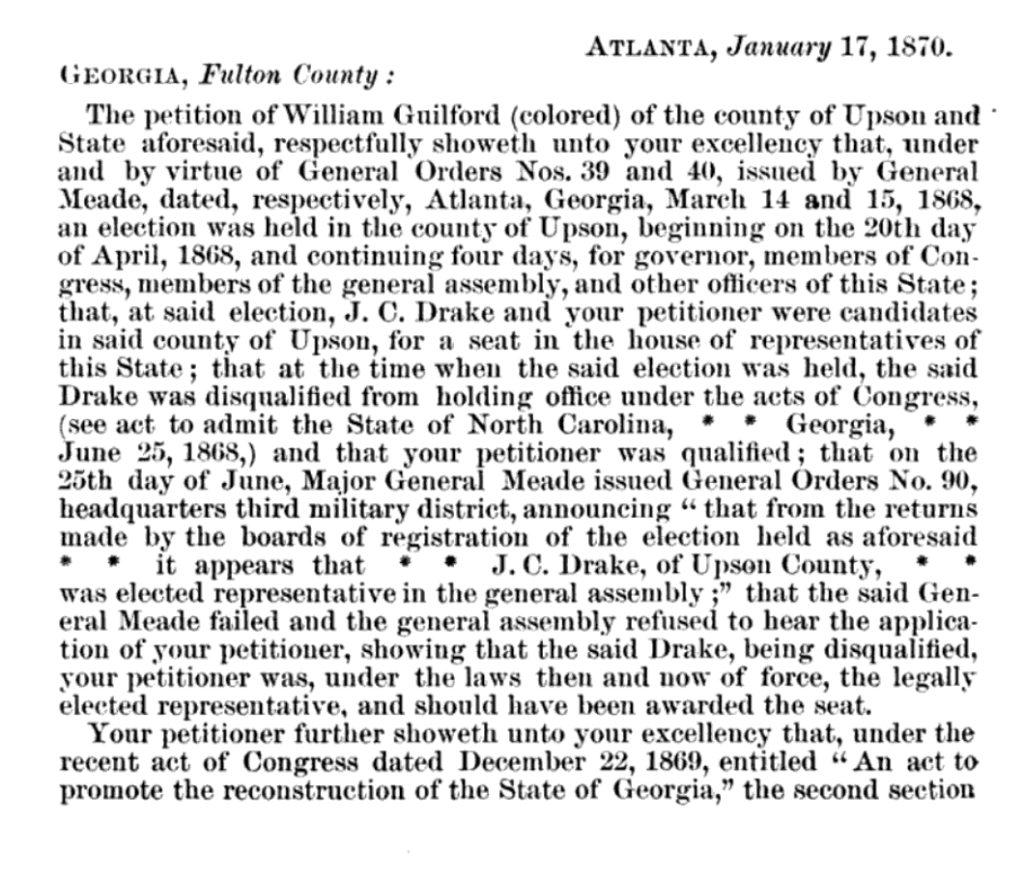
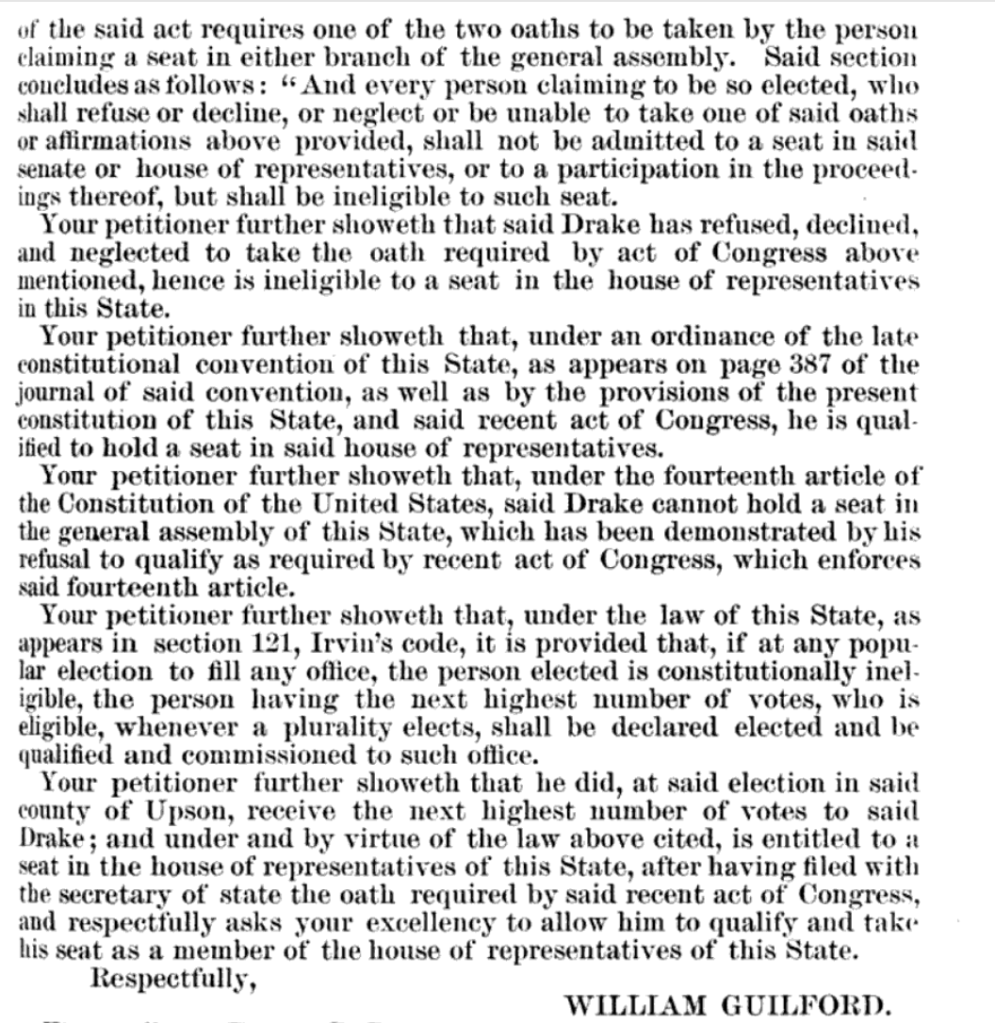
Below is William Guilford’s petition for reinstatement to the Georgia Assembly.
United States. Government Printing Office (1870). “Congressional Serial Set”. United States Congressional Serial Set (1406). U.S. Government Printing Office: 1–24. ISSN1931-2822. Retrieved 2025-03-02.
Called “the oldest and best-known clergyman in the African Methodist Church”, Tunis Gulic Campbell Sr. served as a Reverend, abolitionist activist, civil rights leader, Union Army chaplain, Military Governor, voter registration organizer, Justice of the Peace, delegate to the Georgia Constitutional Convention of 1867–1868, and was one of three Black Georgia state senators in the1868 Georgia General Assembly.
Campbell was born in Jersey City, NJ, and was one of 10 children born to John Campbell, a successful blacksmith and a free person of color, in Middlebrook, NJ. When Campbell was five, a white friend of the Campbell family placed Campbell in an all-white Episcopal school in Babylon, New York, where he attended school until the age of 18 as the only person of color in the school. In his teens, Campbell trained to be a missionary to Liberia through the American Colonization Society, but he grew to oppose the ACS and their stance to resettle Black Americans in West Africa. By 18, Campbell had become an anti-colonization and abolitionist lecturer preaching against slavery and colonization and often joined Frederick Douglass on speaking tours.
During Reconstruction, Campbell worked with the Federal Government in Union-occupied Georgia to help rebuild Georgia’s newly freed Black communities after the abolition of slavery. Soon after Congress established Freedman’s Bureau in 1865, Campbell was appointed to supervise land claims and the resettlement of newly freed people on five Georgia Sea Islands: Ossabaw, Delaware, Colonels, St. Catherine’s, and Sapelo. He settled in McIntosh County along Georgia’s coast and worked to empower the newly freed slaves by promoting education, land ownership, economic opportunities, and political participation. As Bureau Agent and Military Governor to the Sea Islands, Campbell played a key role in assisting Black Americans in coastal Georgia during their transition from slavery to freedom and helped many gain education through newly established Black schools in the area as well as acquire land to start their own farms.
Campbell was a delegate during the Georgia State Constitutional Convention of 1867-68 and served as Senator for the Second Senatorial District, which included Liberty, McIntosh, and Tattnall counties in the Georgia Assembly. As a senator, Campbell served on the Senate’s Petitions and General Education committees. He introduced 15 bills promoting civil rights for Black Georgians in equal education, integrated court juries, homestead exemptions, elimination of imprisonment for debt, full access for Black Georgians to public facilities, and fair voting procedures.
Along with 32 other Black Georgia representatives, Campbell was expelled from the General Assembly in September 1868 under the false claim that while Black Georgians had the right to vote, the Georgia constitution prohibited Black Americans from holding office. Campbell immediately protested the resolution and was one of the loudest speakers defending Black eligibility to hold office, his speech on the topic appearing on the front page of the Atlanta Constitution. While expelled, Tunis continued to build his political presence in the Sea Islands and fight for civil rights, often amid violent threats by white supremacists and the Ku Klux Klan.
Campbell was reinstated in 1871 but lost his bid for re-election in 1872 due to efforts by his enemies to intimidate Black voters. He continued to serve as Justice of The Peace on St. Catherine’s Island, angering many who saw his role as having too much power for a Black official over white Georgians. He would be indicted on multiple trumped-up charges when he defended the rights of Black sailors on ships docked in Darien, Georgia, and was convicted and sentenced to one year of hard labor at a Georgia convict labor camp. Following his imprisonment, Campbell moved to Washington, DC, and continued his political activism. He also published a memoir, Sufferings of the Reverend T. G. Campbell and His Family in Georgia (1877).
Tunis Campbell Sr. died in Boston on December 4, 1891. In the early 2000s, the Gullah/Geechee Nation began holding the Tunis Campbell Celebration to honor the man who had led many formerly-enslaved coastal Georgians to political empowerment and economic prosperity.
Tunis Gulic Campbell, Jr. was a representative of the Georgia Assembly for McIntosh County, GA. He was elected to the Assembly along with his father, Tunis Campbell Sr., a civil rights activist, former Military Governor to five Georgia Sea Islands, and prominent Reverend in the African Methodist Church.
Campbell was born in 1841 in New York, NY to Tunis Campbell Sr. and Harriet Nelson Campbell. He worked before the Civil War as a waiter and storekeeper in New York before coming to coastal Georgia at his father’s request in 1865 to assume management of the newly formed Black schools on St. Catherine’s and Sapalo Islands. Soon after taking over, Campbell’s wife and their adopted son came to the Sea Islands as teachers for the growing schools, which went from 140 children enrolled on June 30, 1865, to 200-250 children enrolled by January 1866.
Campbell served as a messenger at the Georgia Constitutional Convention of 1867-87, where his father was one of 33 Black delegates. Tunis Campbell Sr. campaigned on his son’s behalf in McIntosh County, and both were elected to the Georgia Assembly representing McIntosh County in 1868. Like his father, Campbell was expelled from the Assembly to be reinstated in 1871. In the 1870 Census, Campbell is listed as owning $500 in real estate and $300 in personal property. Campbell died in 1904 in Boston, MA, and is buried along with his father at Woodlawn Cemetery in Everett, MA.
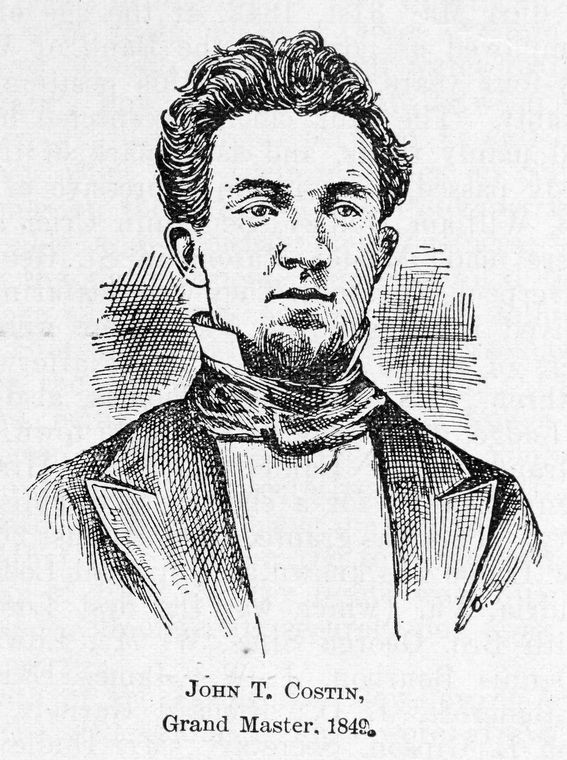
John T. Costin was born in Virginia (East Washington, DC) around 1828. He was a Freemason and Grand Master of a Black Masonic Lodge in the District of Columbia in the late 1840s. After the Civil War, he came to Georgia as a Republican Party organizer. Costin was a barber, preacher and A.M.E Zion minister, and active member of Black Freemasonry. His father had been involved in assisting runaway slaves prior to the Civil War, and despite threats of physical violence in Georgia, Costin persisted, traveling throughout the state to tell people their rights as free men and women. In a letter back to D.C., Costin wrote:
On my return I stopped at another town called Red Hills, where I performed the same duty and organized clubs in each. I arrived in Waynesboro Friday evening. Our mass meeting was largely attended, all classes being present. To my surprise, I was offered the use of the Court House, but in consequence of the excessive heat and the large number of people, we took the grove. There were people at the meeting from a distance of 25 miles. It was a great success. Everything went off peaceable and pleasant. The freedmen declared it to be the first time since their emancipation that they had ever had explained to them their rights before the law. The rebs. cursed me terribly, some threatening to shoot me, but the only thing that occurred was being spit upon by a rebel while passing the street. I took no notice of the insult, because they were nearly 2000 colored persons in the place and nearly every one had fire-arms.
As a Republican Party organizer, civil rights leader, and political activist, Costin earned the support of many Black voters. He was elected to represent Talbot County in the Georgia Constitutional Convention of 1867/68 and in the Georgia Assembly. Just before election day 1868. Just before Election Day 1868, the KKK threatened Costin with physical violence, and he was forced to leave Talbot County. Nonetheless, Costin was elected and reinstated to the State Legislature in January 1870.
The rebs. cursed me terribly, some threatening to shoot me, but the only thing that occurred was being spit upon by a rebel while passing the street. I took no notice of the insult, because they were nearly 2000 colored persons in the place and nearly every one had fire-arms.
From a letter that Costin sent back to DC
According to the 1870 census, John lived in Washington DC with his wife Elizabeth and their children Virginia (17), Harriet (14), John T (12), Annie (10), and Owen (6.) His occupation was listed as a barber. By 1880 the family was still living in Washington DC. Virginia and her husband William Wilkes, a fireman, were living with the family as well as John T., now 21 and working as a store clerk; Anna, who was at the Normal School; and Owen, who was also in school. Harriet, listed as a servant, was also living with the family.
John T. Costin passed away at the age of 60 at his home in Washington, DC on February 28, 1888. He is buried at Harmony Cemetery in Washington, DC.
Born around 1840, George Wallace was a native of Georgia and represented District 20 (Hancock, Baldwin and Washington counties) in middle Georgia in the1868 Georgia Assembly and in the Georgia State Constitutional Convention of 1867-68. Wallace was biracial and was one of the first three Black senators elected in Georgia, the other being Tunis Campbell Sr. Unseated with the other Black members, Wallace was restored to his senate seat in 1870 by an Act of Congress. Wallace served on the Republican state committee in 1868, attended the 1869 Georgia labor convention, and was a delegate to the Republican national convention of 1876. According to the 1870 census, Wallace owned $100 in personal property.
In addition to serving in the Georgia Assembly, Wallace was a founder of the Macon Union League, an organization that demonstrated unwavering support for the Union and was active in the Georgia Educational Association. He represented District 20 in the Georgia State Constitutional Convention, which was the first constitutional convention to include Black delegates and was held in Atlanta. During the convention, Wallace was an outspoken critic of the proposed move of the capital from Milledgeville to Atlanta. As a representative of District 20, which Milledgeville, Wallace proposed putting the move to a state-wide vote. Ironically, the reason the convention was moved from Milledgeville to Atlanta in 1867-1868 was because Milledgeville’s innkeepers refused to allow the Black delegates room and board for the state constitutional convention. Without lodging in Milledgeville for all delegates, US Army General John Pope ordered the convention to be held in Atlanta. The Capital was permanently moved from Milledgeville to Atlanta in 1877.
George Linder was born in 1834 in Laurens County, Georgia. While still enslaved, he founded Strawberry AME Church (pictured above) in 1859. At the conclusion of the Civil War, he attended the 1868 Georgia Constitutional Convention held in Atlanta. He represented the Sixteenth Election District. The convention lasted from December 1867 to March 1868. Required by the federal government, the convention created the new Georgia state constitution. Linder was elected to be a state representative. After being expelled, Linder was quoted saying, “Roust us from here, and we will roust you!”
In addition to being an AME pastor, Linder helped found two other AME churches in Laurens County. He was a successful farmer owning several hundred acres in the Buckeye District, just outside of Dublin, Georgia. He and his first wife, Peggy, had seven children. He had an additional ten children with his second wife, Mary. At some point, Linder moved his family from the farm into Dublin. The Linder family home still stands today.
Edwin Belcher was born on July 31, 1845 to his father and his slave enslaver, Robert E. Belcher and an unknown enslaved woman near Abbeville, SC. In an 1873 letter to abolitionist leader William Lloyd Garrison, Belcher wrote briefly of his parentage and early upbringing: “I am a Colored man, was born the Slave of my father in South Carolina in 1845. At an early age through the exertions of my mother I was sent to the North where I was attending school when the war Commenced in 1861.” At the start of the war, Belcher was just 16 years old, living in Philadelphia, PA and attending the all-white Pennsylvania High-School. He immediately enlisted the Union Army, leaving school to fight for the United States.
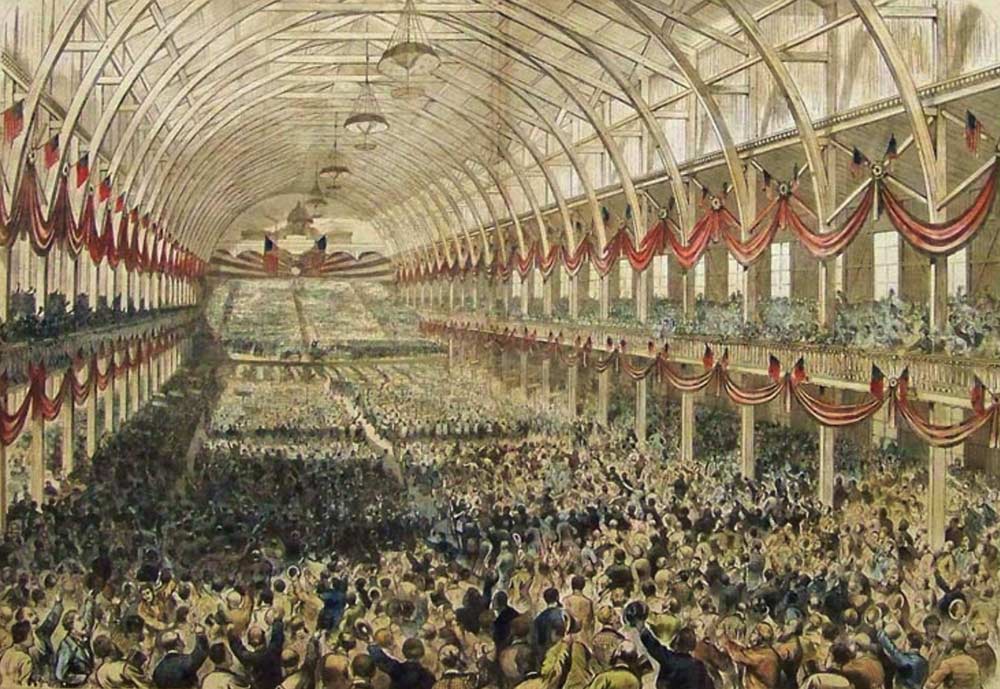
Belcher attended the 1876 Republican National Convention.
Because of his light complexion Belcher could pass for white. He rose through the ranks of the Union Army to a command position. When whites in Georgia learned he was Black he responded “My blood has dyed the soil of the Sunny South as deep as any other soldiers… My service during the war was just as acceptable as any other man’s and was appreciated.” During the Civil War, Belcher was both imprisoned in a Confederate camp and suffered a blow to the skill which caused him to have seizures for the rest of his life. Belcher engaged in several battles during the Civil War, his last engagement was in Atlanta during Sherman’s March to the Sea. His father, Robert, rose to the rank of Colonel in the Confederate Army and commanded a Confederate regiment.
After the Civil War, Belcher held several key positions for the U.S. Government and in Georgia politics. He was a revenue tax officer in Augusta, a Wilkes County representative for the 1868 Georgia Legislature and a member of the Georgia Constitutional Convention, also representing Wilkes County. Belcher was not expelled with his other colleagues in 1868 because he was so light skinned. In 1872, Belcher graduated from Howard University Law School (founded in 1868) and was one of the first graduates of Howard Law. He was admitted to the Washington D.C. bar following graduation. (His brother Eugene R. Belcher was also an early graduate of Howard University Law School.) Edwin Belcher also served as Macon, GA Postmaster and was working as a route agent between Atlanta and Augusta at the time of his death. Edwin Belcher married Ida and they had a 9-month infant named William S. Belcher (who would later go by Sumner) at the time of the 1870 census.
Belcher died in Augusta, Georgia on January 7, 1883 at the age of 37 after a two-month long illness caused by typhoid-pneumonia. A special dispatch to the Chicago Tribune written in Atlanta, Georgia published Belcher’s obituary describing him as “without exception he was the most powerful debater and stump-speaker of his race in this section and probably in the South. His appearance was commanding, and his reputation as an orator was such like that of Bob Toombs, he never spoke to an empty seat.” Edwin Belcher’s death received national attention. News of his passing was published in the Chicago Tribune, The St. Louis Post-Dispatch, The St. Louis Globe-Democrat, Lewiston, Maine’s Sun-Journal, The Dayton Herald, The Savannah Morning News, and The Daily Chronicle of Knoxville, Tennessee. The Atlanta-based author concluded Belcher’s obituary saying, “His mother resides here.” Edwin Belcher is buried at Arlington National Cemetery in Arlington, Virginia.
Aaron Alpeoria Bradley (c. 1815–1881) was a lawyer and civil rights activist in the United States. He was born into slavery on a Plantation in South Carolina around 1815 and was of mixed ethnicity. He escaped slavery, went North, and became a lawyer in Massachusetts in 1856. He was the third African American admitted to the Massachusetts Bar. At the end of the Civil War, Bradley moved to Savannah in 1865. He applied for the Georgia Bar but was denied admittance due to his race and controversial political activism against racial injustice. He became a lawyer in neighboring South Carolina and continued to practice law in Georgia without a license until 1875.
Bradley was elected as a representative to Georgia’s Constitutional Convention of 1867/68 and to the Georgia Assembly as one of 3 Senators. He represented District 1, which covered Chatham, Bryan and Effingham counties.
Bradley was a powerful orator and outspoken civil rights activist. He believed in the freedom of the Black race and championed all black causes. He is accredited as an early proponent of what would become the Black Power Movement, often calling for liberation and escalation of Black Americans in his speeches. He was also an anti-capitalist and held beliefs that predated the Populist Movement decades later. Bradley also pushed on shared social issues like the Homestead Acts, labor reform, end to debtors’ prison, which banded poor whites with many Black Georgians and fueled hatred among many white Georgians.


 The Original 33