Robert Lumpkin-Macon County

Robert Lumpkin was born enslaved in Virginia. He lived in Georgia for 50 years, with his last enslaver being Mrs. Phil Cook. After the Civil War, he was freed and elected to the Georgia Assembly from Macon County. Located in South Central Georgia, Macon County is home to Oglethorpe and Andersonville, Georgia, where 13,000 Union soldiers died as prisoners of war during the Civil War. 

Like the other Original 33, Lumpkin was elected in 1868, expelled, and reseated in 1870, but he died of pneumonia one month after being reseated in February 1870.  In that year’s census, his widow’s possessions are listed at $400 in real estate and $432 in personal property. He is buried in a segregated, Black cemetery in Oglethorpe, Georgia. The inscription on his grave reads: “ Hon. Robert Lumpkin, died Feb. 17, 1870. Sail on, Oh ship of state; sail on.” 

Lumpkin’s son, Horace (1857-1930), was also born into slavery and founded Lumpkin Academy in 1886, the first school for formal education in Macon County for Black students. Horace went to Knoxville College, Tennessee, and Atlanta University. Students at Lumpkin Academy studied reading, writing, arithmetic, English, science, geography, history, mathematics, and astronomy. 

According to the Historical Marker Database: “Professor Lumpkin, as he was known, often sought jobs around town in order to teach his students agriculture, carpentry and landscaping. Music and bands were also available. When Rosenwald Schools for black children opened their doors in Macon County in the early 1930s. Lumpkin Academy, its founder deceased, and its aging building in disrepair closed its doors permanently.” 
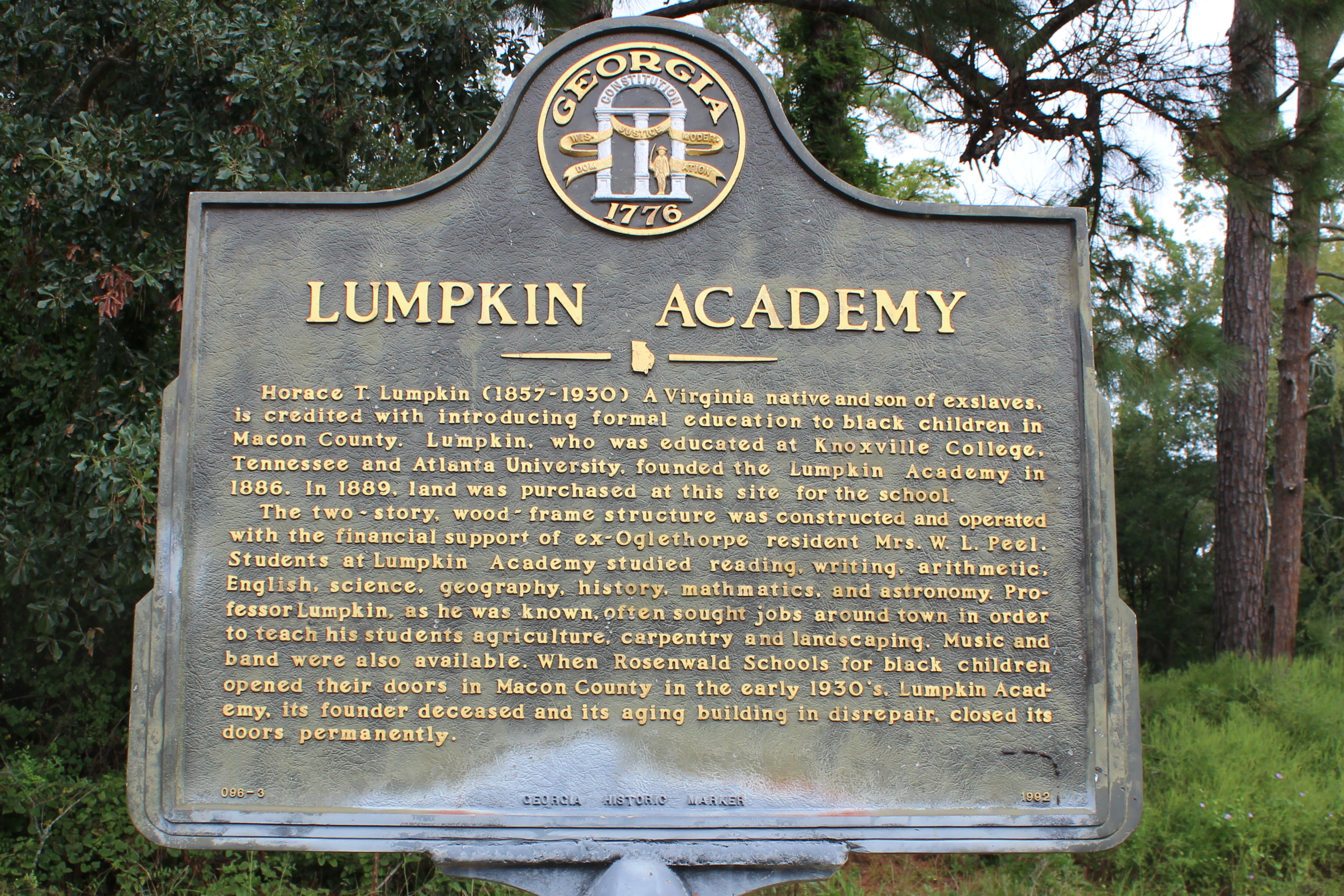
Lumpkin Acadamy Historical Marker. See Georgia History.com

Horace Lumpkin’s burial marker reads “Professor H.T Lumpkin, Age Unknown, 8-28-1930.”

REFERENCES:

Foner, Eric. Foner, Eric. Freedom’s Lawmakers. LSU Press, 1996. p 137

Lumpkin Acadamy https://www.hmdb.org/m.asp?m=27258

Robert Lumpkin Sr., U.S. Federal Census Mortality Schedules. https://www.ancestry.com/search/collections/8756/records/405029?tid=&pid=&queryId=c64c4242-1a52-4a7a-b247-6957b50b9e5d&_phsrc=RBh131&_phstart=successSource

Horace Lumpkin, Find A Grave: https://www.findagrave.com/memorial/249443426/horace-t-lumpkin

Francis H. Fyall-Macon County

Francis Henry Fyall was one of 29 African American men that made up the House of Representatives of the General Assembly of Georgia, which first met on July 4, 1868. Twenty-five of these men were identifiable as Black, per the color of their skin, but four were racially ambiguous. Fyall was one of those four.

The first method of attack by hostile white legislators was to question each representative’s eligibility to serve the county. For Fyall, claims were made that he was a resident of Macon, Georgia, which was located in Bibb County, and not an actual resident of Macon County. In later testimony, Fyall explained that he had made a home in Macon County but was run out with threats of violence against him and his wife.

The second method of attack was to question Fyall’s race. By law, the white legislators had determined Black men ineligible to hold office. Twenty-five men were immediately removed, and a committee of five white men was formed to decide the fate of the four racially ambiguous. Fyall is called to testify, and he described his upbringing; the child of two white, Charleston French parents, his mother died when he was 6 years old. Another witness was brought to the stand and described Fyall’s mother as a mulatto woman and expressed he could find 100 more witnesses who would attest to the same. It was also described in the proceedings that Fyall was sold as a slave to a Mr. Habersham of Savannah, later enslaved by Dr. M.S. Thompson, and last, the property of Judge O.A. Lochrane.

They gave their determination on September 15th, stating: “they find the said F. H. Fyall to have more than one-eighth negro blood in his veins, and in accordance with the action of this House declaring the ineligibility of negroes to hold office under the Constitution of this State, respectfully offer the Following: Resolved, That F. H. Fyall is ineligible, under the Constitution, to a seat as a member of this body, and after the passage of this resolution, that his name be dropped from the roll.”

On September 18th, F.H. Fyall presented a motion, with the support of 14 white senators, 20 white Republicans, and 28 African American representatives, titled the “Memorial to the Members of the Legislature of Georgia and Others, Relative to the Illegal Organization of that Body Under the Reconstruction Acts.” The action did almost nothing to deter his fate of expulsion.

By April of 1869, he was put on trial for perjury, related to the false swearing that he lived in Macon County. That case was short-lived, as his claim was made orally and not written. Georgia Governor Rufus Bullock promoted Fyall to train hand on freight trains for the Western and Atlantic Railroad. In September of 1869, while traveling through a rock culvert at the crossing of East Tennessee and Georgia Railroad, he was knocked on the head by the culvert and killed. His corpse was sent “down the state road,” but information about his burial site has not been found.