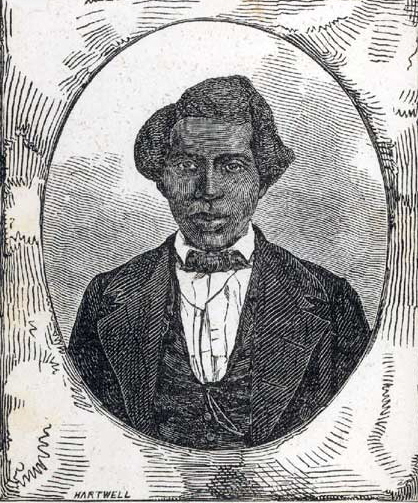
Called “the oldest and best-known clergyman in the African Methodist Church”, Tunis Gulic Campbell Sr. served as a Reverend, abolitionist activist, civil rights leader, Union Army chaplain, Military Governor, voter registration organizer, Justice of the Peace, delegate to the Georgia Constitutional Convention of 1867–1868, and was one of three Black Georgia state senators in the1868 Georgia General Assembly.
Campbell was born in Jersey City, NJ, and was one of 10 children born to John Campbell, a successful blacksmith and a free person of color, in Middlebrook, NJ. When Campbell was five, a white friend of the Campbell family placed Campbell in an all-white Episcopal school in Babylon, New York, where he attended school until the age of 18 as the only person of color in the school. In his teens, Campbell trained to be a missionary to Liberia through the American Colonization Society, but he grew to oppose the ACS and their stance to resettle Black Americans in West Africa. By 18, Campbell had become an anti-colonization and abolitionist lecturer preaching against slavery and colonization and often joined Frederick Douglass on speaking tours.
During Reconstruction, Campbell worked with the Federal Government in Union-occupied Georgia to help rebuild Georgia’s newly freed Black communities after the abolition of slavery. Soon after Congress established Freedman’s Bureau in 1865, Campbell was appointed to supervise land claims and the resettlement of newly freed people on five Georgia Sea Islands: Ossabaw, Delaware, Colonels, St. Catherine’s, and Sapelo. He settled in McIntosh County along Georgia’s coast and worked to empower the newly freed slaves by promoting education, land ownership, economic opportunities, and political participation. As Bureau Agent and Military Governor to the Sea Islands, Campbell played a key role in assisting Black Americans in coastal Georgia during their transition from slavery to freedom and helped many gain education through newly established Black schools in the area as well as acquire land to start their own farms.
Campbell was a delegate during the Georgia State Constitutional Convention of 1867-68 and served as Senator for the Second Senatorial District, which included Liberty, McIntosh, and Tattnall counties in the Georgia Assembly. As a senator, Campbell served on the Senate’s Petitions and General Education committees. He introduced 15 bills promoting civil rights for Black Georgians in equal education, integrated court juries, homestead exemptions, elimination of imprisonment for debt, full access for Black Georgians to public facilities, and fair voting procedures.
Along with 32 other Black Georgia representatives, Campbell was expelled from the General Assembly in September 1868 under the false claim that while Black Georgians had the right to vote, the Georgia constitution prohibited Black Americans from holding office. Campbell immediately protested the resolution and was one of the loudest speakers defending Black eligibility to hold office, his speech on the topic appearing on the front page of the Atlanta Constitution. While expelled, Tunis continued to build his political presence in the Sea Islands and fight for civil rights, often amid violent threats by white supremacists and the Ku Klux Klan.
Campbell was reinstated in 1871 but lost his bid for re-election in 1872 due to efforts by his enemies to intimidate Black voters. He continued to serve as Justice of The Peace on St. Catherine’s Island, angering many who saw his role as having too much power for a Black official over white Georgians. He would be indicted on multiple trumped-up charges when he defended the rights of Black sailors on ships docked in Darien, Georgia, and was convicted and sentenced to one year of hard labor at a Georgia convict labor camp. Following his imprisonment, Campbell moved to Washington, DC, and continued his political activism. He also published a memoir, Sufferings of the Reverend T. G. Campbell and His Family in Georgia (1877).
Tunis Campbell Sr. died in Boston on December 4, 1891. In the early 2000s, the Gullah/Geechee Nation began holding the Tunis Campbell Celebration to honor the man who had led many formerly-enslaved coastal Georgians to political empowerment and economic prosperity.
A book was written about his life titled Freedom’s Shore: Tunis Campbell and the Georgia Freedmen. The rights to the book were purchased by Malcolm Jamal Warner.
 The Original 33