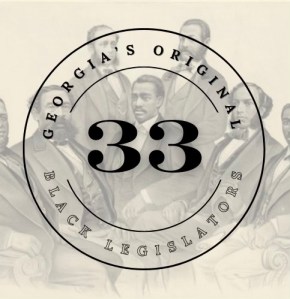
Monday Floyd was born into slavery in Greene County in 1809 and worked as a house carpenter after the war. Because enslaved people were not permitted to learn to read and write, Floyd entered the Georgia Assembly, confessing he could read only “a little.” Many legislators derided Floyd and other elected freedmen, such as Eli Barnes, a mechanic, for their lack of literacy and education. Prominent minister and representative Henry M. Turner, scolded their detractors in the Assembly, saying, “These gentlemen do not consider for a moment the dreadful hardships which these people have endured, and especially those who in any way endeavored to acquire an education.” Turner and other Black Republicans saw Floyd as an example of the need for public education for newly freed Black Georgians, which became a cornerstone mission for many Black politicians.
Floyd was elected to two terms in the Georgia Assembly. Monday was one of several of the Original 33 that received death threats following their election to public office and their 1870 reinstatement. In 1871 Monday testified before the U.S. Congress on the threats he had received, including a letter from the Ku Klux Klan:
You are requested to resign Your place in the Legislature and retire to private life. We think it the best thing You can do under the present state of affairs. And we hop will comply without further trouble and save us from being provoked to put a dire threat into execution… for we swear by the powers of both Light and Darkness that no other Negro shall ever enter the Legislative Halls of the South. Sir, a word wot the wise is sufficient. Heed, we beseech you, friendly advice, and take warning.
Haste, O Mondy, to be wise,
Stay not for the morrow’s sun.
K.K.K.
You are requested to resign Your place in the Legislature and retire to private life. We think it the best thing You can do under the present state of affairs. And we hop will comply without further trouble and save us from being provoked to put a dire threat into execution… for we swear by the powers of both Light and Darkness that no other Negro shall ever enter the Legislative Halls of the South. Sir, a word wot the wise is sufficient. Heed, we beseech you, friendly advice, and take warning.
From Monday Floyd’s testimony about the KKK
In December 1870, Floyd was threatened and shot in his home in Madison, Georgia, by the Ku Klux Klan. The Klan returned 3 days later, and Floyd left Madison for Atlanta. Floyd was not the only legislator to be threatened and attacked in the area. Abram Colby of Greene County was also violently beaten by a group of white men as well as Alfred Richardson, a Black legislator from Clarke County, just north of Greene County.
REFERENCES:
Drago, Edmund. Black Politicians and Reconstruction in Georgia: A Splendid Failure. UGA Press. 1992. p 38
Note from KKK in The Making of a Southerner p 93. https://books.google.com/books?id=VCg8T6XBMvwC&pg=PA93#v=onepage&q&f=false
https://en.wikipedia.org/wiki/Monday_Floyd
US Freedman’s Bureau document. https://drive.google.com/drive/folders/1K-FJBfqVUGT78L_fUoETbE0IeZqEOk3_
 The Original 33