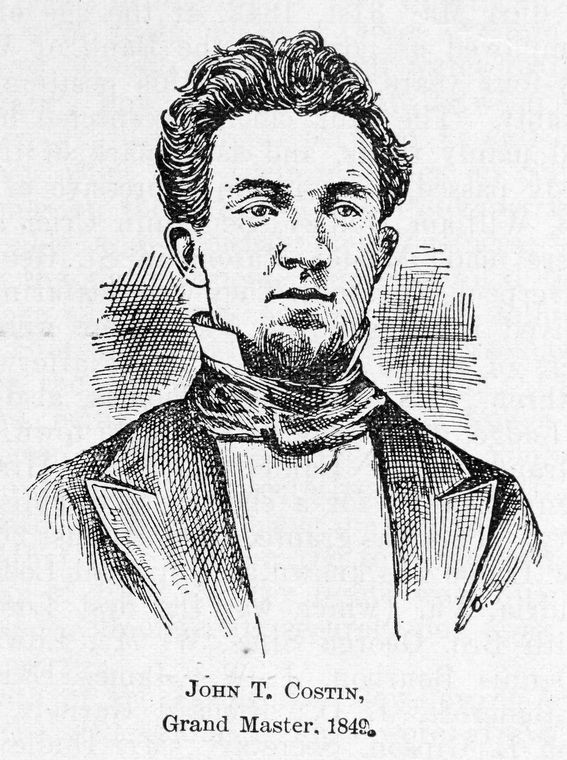
John T. Costin was born in Virginia (East Washington, DC) around 1828. He was a Freemason and Grand Master of a Black Masonic Lodge in the District of Columbia in the late 1840s. After the Civil War, he came to Georgia as a Republican Party organizer. Costin was a barber, preacher and A.M.E Zion minister, and active member of Black Freemasonry. His father had been involved in assisting runaway slaves prior to the Civil War, and despite threats of physical violence in Georgia, Costin persisted, traveling throughout the state to tell people their rights as free men and women. In a letter back to D.C., Costin wrote:
On my return I stopped at another town called Red Hills, where I performed the same duty and organized clubs in each. I arrived in Waynesboro Friday evening. Our mass meeting was largely attended, all classes being present. To my surprise, I was offered the use of the Court House, but in consequence of the excessive heat and the large number of people, we took the grove. There were people at the meeting from a distance of 25 miles. It was a great success. Everything went off peaceable and pleasant. The freedmen declared it to be the first time since their emancipation that they had ever had explained to them their rights before the law. The rebs. cursed me terribly, some threatening to shoot me, but the only thing that occurred was being spit upon by a rebel while passing the street. I took no notice of the insult, because they were nearly 2000 colored persons in the place and nearly every one had fire-arms.
As a Republican Party organizer, civil rights leader, and political activist, Costin earned the support of many Black voters. He was elected to represent Talbot County in the Georgia Constitutional Convention of 1867/68 and in the Georgia Assembly. Just before election day 1868. Just before Election Day 1868, the KKK threatened Costin with physical violence, and he was forced to leave Talbot County. Nonetheless, Costin was elected and reinstated to the State Legislature in January 1870.
The rebs. cursed me terribly, some threatening to shoot me, but the only thing that occurred was being spit upon by a rebel while passing the street. I took no notice of the insult, because they were nearly 2000 colored persons in the place and nearly every one had fire-arms.
From a letter that Costin sent back to DC
According to the 1870 census, John lived in Washington DC with his wife Elizabeth and their children Virginia (17), Harriet (14), John T (12), Annie (10), and Owen (6.) His occupation was listed as a barber. By 1880 the family was still living in Washington DC. Virginia and her husband William Wilkes, a fireman, were living with the family as well as John T., now 21 and working as a store clerk; Anna, who was at the Normal School; and Owen, who was also in school. Harriet, listed as a servant, was also living with the family.
John T. Costin passed away at the age of 60 at his home in Washington, DC on February 28, 1888. He is buried at Harmony Cemetery in Washington, DC.
 The Original 33