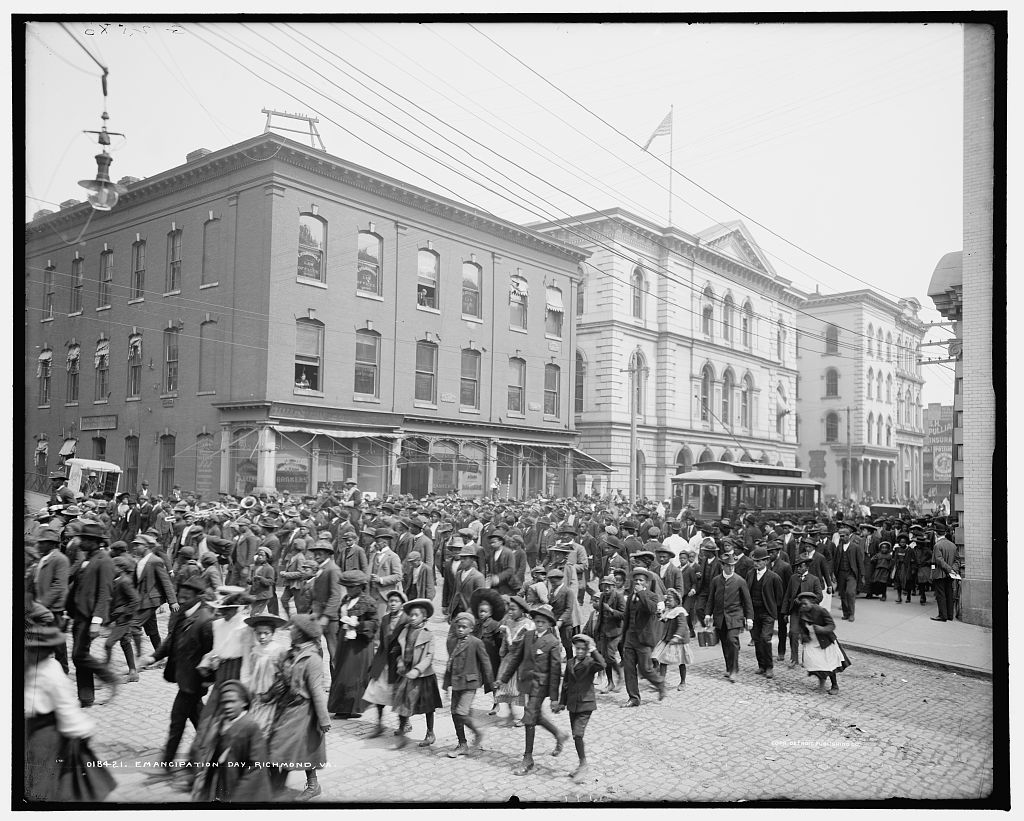
William A. Guilford (February 5, 1844 – October 1909) was a barber and state legislator from Upson County, Georgia. Guilford was a representative of Georgia’s constitutional congress in 1868 and was an elected representative in Georgia’s assembly during the 1868–1870 term. A Republican, he helped found the Republican Party in Upson County. He organized the Upson County’s Emancipation Celebration, which still occurs on or near May 19th.
Emancipation Day celebration in Richmond, Virginia. Image courtesy of the Library of Congress.
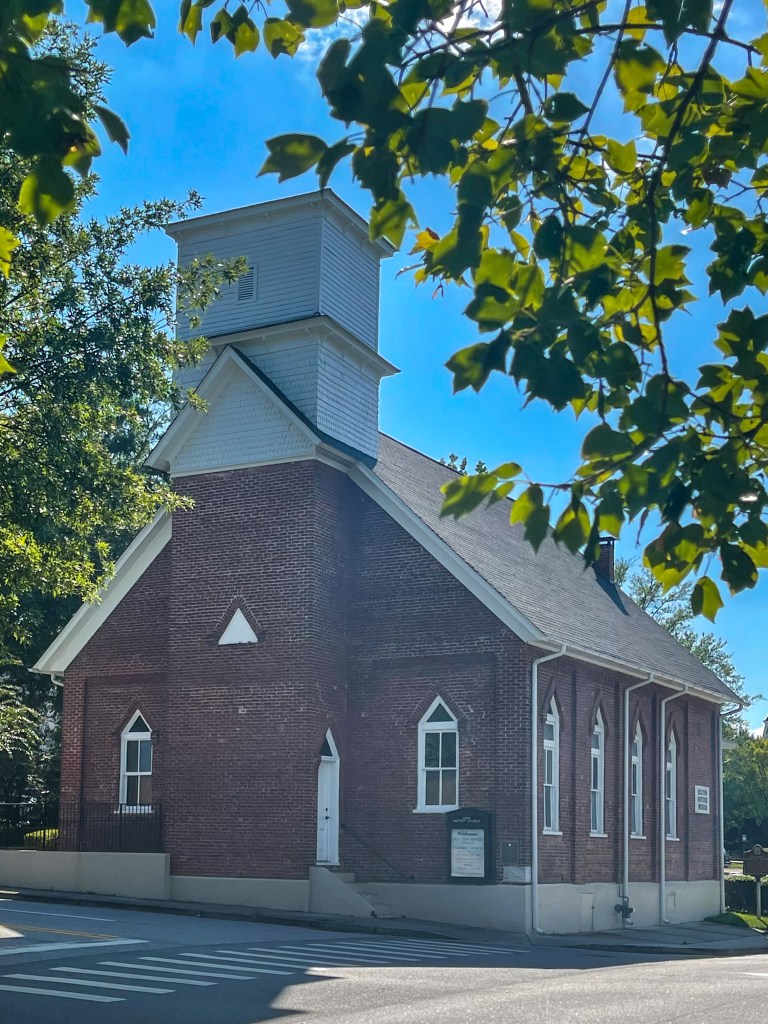
William Guilford’s father, Guilford Speer, operated a harness and shoe shop in Thomaston, dating back to the 1840s. Guilford was also a founding organizer of St. Mary’s A.M.E. Church. Guilford and his wife, Lourinda, had at least 8 children including William (who died before 1870), Guilford, Duffield, Lincoln, Douglass, Richard, Ludie, Benjamin, and Lidie (Lydia). He owned 12 acres of land in Thomaston, Georgia. Guilford was one of several witnesses on behalf of political activist William Fincher of Pike County, who was accused of vagrancy in 1868. The case was submitted to the U.S. Congress as an example of a violation of Civil Rights. The jury sentenced Fincher to a year of hard labor on the public roads.
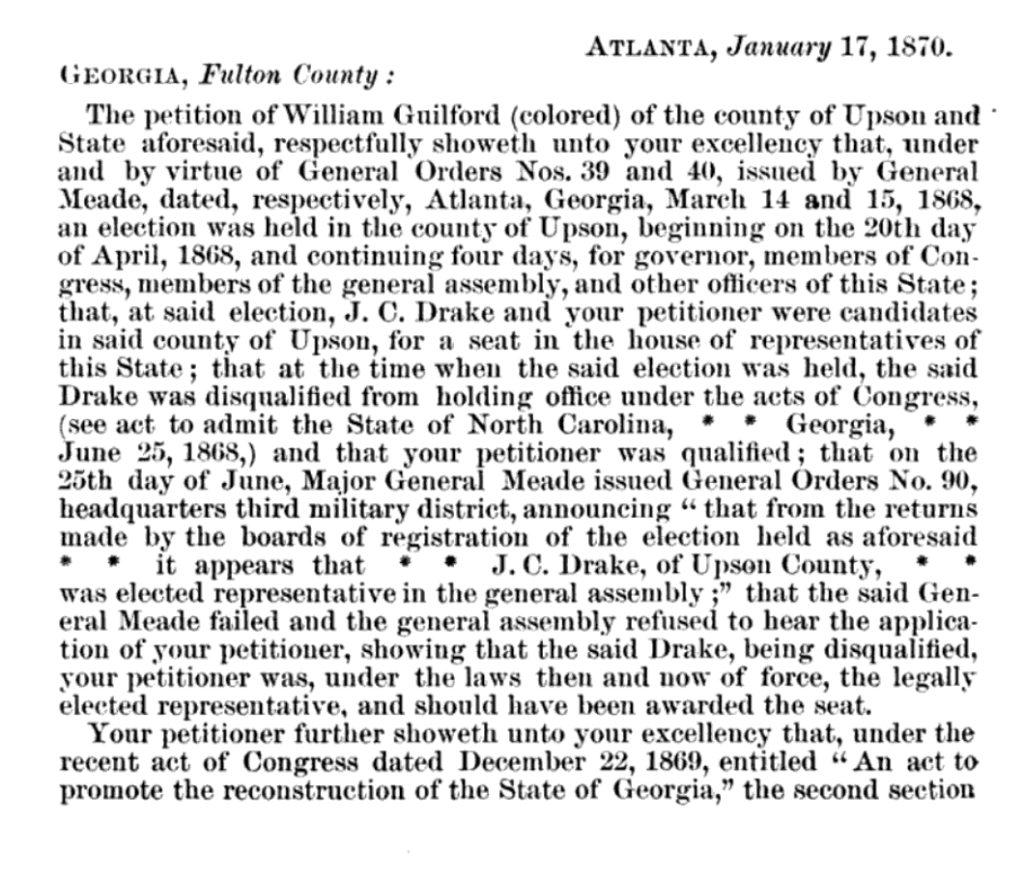
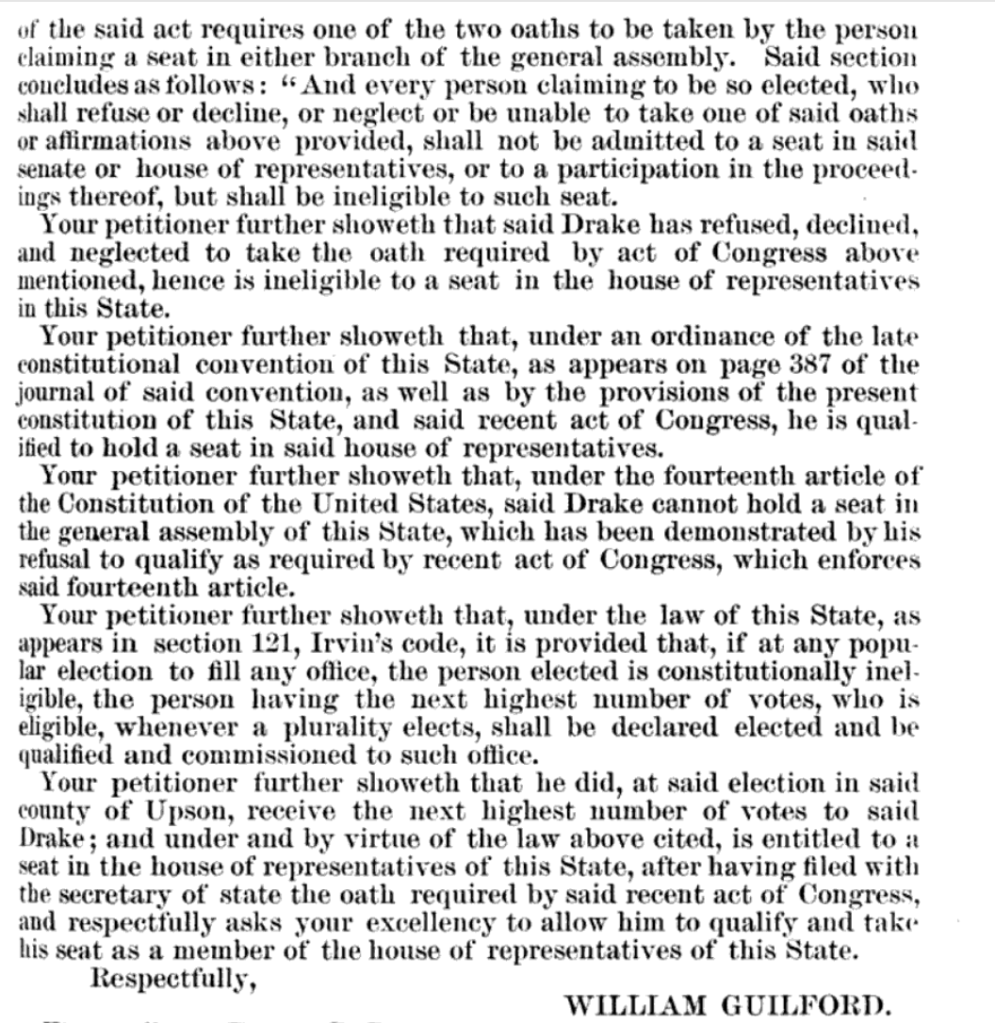
Below is William Guilford’s petition for reinstatement to the Georgia Assembly.
United States. Government Printing Office (1870). “Congressional Serial Set”. United States Congressional Serial Set (1406). U.S. Government Printing Office: 1–24. ISSN1931-2822. Retrieved 2025-03-02.
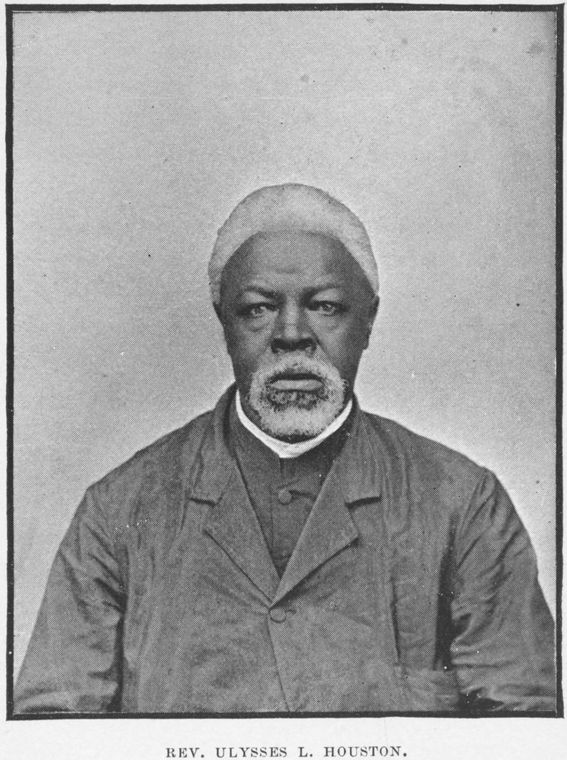
Ulysses L. Houston (1825-1889) was a pastor and state legislator in Georgia. Considered a leading citizen of the Black community in Savannah, he was elected to the Georgia State Legislature as a representative of Bryan County. Born into slavery in Grahamville, South Carolina, he moved with his enslaver, Moses Henderson, to serve in the Henderson home. Licensed to preach in 1855, he was the first member of the Third African Baptist Church, which is now the First Bryan Baptist Church in Savannah, Georgia. He then served as a pastor from 1861 until his passing in 1889. He was one of the church leaders who met with General Sherman in Savannah to discuss the future of the Black community in Savannah. In addition to his church leadership, he was a founding member of the fraternal lodge, Eureka Lodge, No. 1, A. F. and A. M. He also founded Houston Baptist Church in Port Wentworth.
Houston was married to Henrietta. They had four sons and one daughter. He was a respected man around the South. When he passed, over 7000 people attended his funeral. He is buried inLaurel Grove South Cemetery.
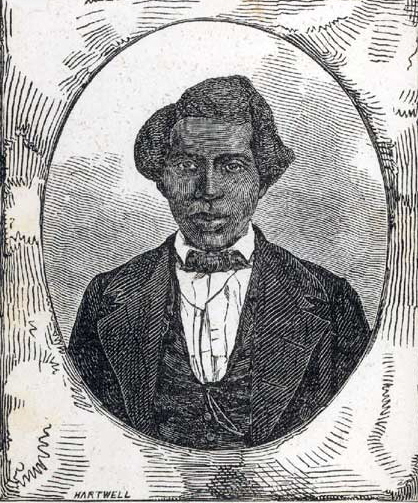
Called “the oldest and best-known clergyman in the African Methodist Church”, Tunis Gulic Campbell Sr. served as a Reverend, abolitionist activist, civil rights leader, Union Army chaplain, Military Governor, voter registration organizer, Justice of the Peace, delegate to the Georgia Constitutional Convention of 1867–1868, and was one of three Black Georgia state senators in the1868 Georgia General Assembly.
Campbell was born in Jersey City, NJ, and was one of 10 children born to John Campbell, a successful blacksmith and a free person of color, in Middlebrook, NJ. When Campbell was five, a white friend of the Campbell family placed Campbell in an all-white Episcopal school in Babylon, New York, where he attended school until the age of 18 as the only person of color in the school. In his teens, Campbell trained to be a missionary to Liberia through the American Colonization Society, but he grew to oppose the ACS and their stance to resettle Black Americans in West Africa. By 18, Campbell had become an anti-colonization and abolitionist lecturer preaching against slavery and colonization and often joined Frederick Douglass on speaking tours.
During Reconstruction, Campbell worked with the Federal Government in Union-occupied Georgia to help rebuild Georgia’s newly freed Black communities after the abolition of slavery. Soon after Congress established Freedman’s Bureau in 1865, Campbell was appointed to supervise land claims and the resettlement of newly freed people on five Georgia Sea Islands: Ossabaw, Delaware, Colonels, St. Catherine’s, and Sapelo. He settled in McIntosh County along Georgia’s coast and worked to empower the newly freed slaves by promoting education, land ownership, economic opportunities, and political participation. As Bureau Agent and Military Governor to the Sea Islands, Campbell played a key role in assisting Black Americans in coastal Georgia during their transition from slavery to freedom and helped many gain education through newly established Black schools in the area as well as acquire land to start their own farms.
Campbell was a delegate during the Georgia State Constitutional Convention of 1867-68 and served as Senator for the Second Senatorial District, which included Liberty, McIntosh, and Tattnall counties in the Georgia Assembly. As a senator, Campbell served on the Senate’s Petitions and General Education committees. He introduced 15 bills promoting civil rights for Black Georgians in equal education, integrated court juries, homestead exemptions, elimination of imprisonment for debt, full access for Black Georgians to public facilities, and fair voting procedures.
Along with 32 other Black Georgia representatives, Campbell was expelled from the General Assembly in September 1868 under the false claim that while Black Georgians had the right to vote, the Georgia constitution prohibited Black Americans from holding office. Campbell immediately protested the resolution and was one of the loudest speakers defending Black eligibility to hold office, his speech on the topic appearing on the front page of the Atlanta Constitution. While expelled, Tunis continued to build his political presence in the Sea Islands and fight for civil rights, often amid violent threats by white supremacists and the Ku Klux Klan.
Campbell was reinstated in 1871 but lost his bid for re-election in 1872 due to efforts by his enemies to intimidate Black voters. He continued to serve as Justice of The Peace on St. Catherine’s Island, angering many who saw his role as having too much power for a Black official over white Georgians. He would be indicted on multiple trumped-up charges when he defended the rights of Black sailors on ships docked in Darien, Georgia, and was convicted and sentenced to one year of hard labor at a Georgia convict labor camp. Following his imprisonment, Campbell moved to Washington, DC, and continued his political activism. He also published a memoir, Sufferings of the Reverend T. G. Campbell and His Family in Georgia (1877).
Tunis Campbell Sr. died in Boston on December 4, 1891. In the early 2000s, the Gullah/Geechee Nation began holding the Tunis Campbell Celebration to honor the man who had led many formerly-enslaved coastal Georgians to political empowerment and economic prosperity.
William Henry Harrison (September 1843-?) was in Sparta, Hancock County, Georgia, as Bill Thomas. His parents were Eliza and Harrison McLane. When his father passed away, he was enslaved at the age of 14 by Judge James Thomas, the father-in-law to Linton Stephens, the half-brother of Alexander Stephens, the vice president of the Confederacy. Harrison served as Thomas’s body servant, a person who served as a personal care attendant to their enslaver. While it was illegal to teach African Americans to read and write, it was known that Bill Thomas was literate.
There isn’t a lot known about Harrison. Still, it is known that he was part of an attempted insurrection on September 13, 1863, in Sparta, GA, when approximately 100 enslaved people gathered together in a wooded area east of Sparta, GA. Identified as one of the ringleaders of this attempt, his life was spared but not without punishment. Likely due to his relationship with the Thomas and Stephens families, he did escape execution by hanging. Also, due to his relationship with Thomas, it is believed he would have been present for many discussions about the Confederacy and the Civil War at Thomas’s home.
After the war, Bill Thomas changed his name to William Henry Harrison. Harrison was a delegate to the Constitutional Convention in 1868 and was elected state representative for Hancock County alongside Eli Barnes. In 1872, he testified to Congress on the activities of the Ku Klux Klan in Hancock County. At this time, he shared that he would have to stay up late to guard his land from the KKK, and he often received threatening letters from them.
Members of Harrison’s family are said to be buried at the Brown Chapel AME Cemetery in Hancock County, but it is not known where Harrison is buried.
REferences:
“Insurrection in Hancock County: Revolt Forges a State Leader.” Reflections, Volume XIV, No 1. June/July 2017. p 1, 6.
Tunis Gulic Campbell, Jr. was a representative of the Georgia Assembly for McIntosh County, GA. He was elected to the Assembly along with his father, Tunis Campbell Sr., a civil rights activist, former Military Governor to five Georgia Sea Islands, and prominent Reverend in the African Methodist Church.
Campbell was born in 1841 in New York, NY to Tunis Campbell Sr. and Harriet Nelson Campbell. He worked before the Civil War as a waiter and storekeeper in New York before coming to coastal Georgia at his father’s request in 1865 to assume management of the newly formed Black schools on St. Catherine’s and Sapalo Islands. Soon after taking over, Campbell’s wife and their adopted son came to the Sea Islands as teachers for the growing schools, which went from 140 children enrolled on June 30, 1865, to 200-250 children enrolled by January 1866.
Campbell served as a messenger at the Georgia Constitutional Convention of 1867-87, where his father was one of 33 Black delegates. Tunis Campbell Sr. campaigned on his son’s behalf in McIntosh County, and both were elected to the Georgia Assembly representing McIntosh County in 1868. Like his father, Campbell was expelled from the Assembly to be reinstated in 1871. In the 1870 Census, Campbell is listed as owning $500 in real estate and $300 in personal property. Campbell died in 1904 in Boston, MA, and is buried along with his father at Woodlawn Cemetery in Everett, MA.
Born in Charleston, South Carolina, in 1833, Thomas Milton Allen was elected to represent Jasper County in 1868. Additionally, Allen testified about the actions of the Ku Klux Klan. He testified that two men came to his door right after he was expelled to intimidate him into voting for the Democrats of Jasper County at the next election.
In his testimony, he shared that men gathered in his yard on October 16, 1868, and demanded that he give them a light. Unable to find anything, his brother-in-law, Emanuel, offered to go outside to give the group of men a light. Emanuel was shot twice and bled to death.
Allen also received a threatening letter from the Ku Klux Klan. The letter was threatening his life. While the letter was signed by the KKK, it said, “My word to you, Tom, is to stay home if you value your life, and not vote at all, and advise all of your race to do the same thing. You are marked and closely watched by K.K.K.
After these threats, his family decided to move permanently to Marietta, Georgia, where they had been spending some of their time. He was a founding member of Zion Baptist Church in Marietta, Georgia. He was selected to be the church’s second pastor, where he served from 1869 to 1885. He helped organize other churches in the Marietta area. He founded the first association for Black churches, called the Kennesaw Circuit. He died in 1909 and is buried in the Marietta City Cemetery.
Zion Baptist Church
Allen was married to Priscilla. According to the 1880 Census, they raised at least eight children in Marietta, Georgia.
Thomas Beard represented Richmond County, home to Augusta, Georgia, in the 1868 Georgia Assembly. Along with Henry M. Turner, Tunis Campbell Sr., and John T. Costin, Beard formed the Black Republican Party of Georgia around 1865. Education of newly freed Black Americans was a key mission of the organization. It stated that “Free Schools and churches are the guardians of civil and religious liberty.” Through their political party and other political work and activism, Beard and his colleagues campaigned for universal public education for all Georgians in the Georgia Assembly. After being reinstated to the Georgia Assembly in 1870, Beard and representative Edwin Belcher demanded the word “color” be removed from a public education bill, which could have paved the way to integrated schools in Georgia. The measure passed, however, with a separate but equal clause.
Beard married Caroline Jane Snowden of Charleston, SC. They had one son, James Randolph Beard. In the 1870 census, Thomas and Caroline are both listed as “mulatto,” an outdated and offensive racial classification for people with mixed African and European ancestry. (See here. ) In the census, Thomas is listed as working as a “Clerk In Revine Dept.” with his wife Caroline (27) and their 3 children, James Randolph, Celeste and and Eliza.Thomas Beard died in Augusta, Georgia, in 1918 at the age of 80. He and Caroline are buried at Cedar Grove Cemetery in Augusta, Georgia.
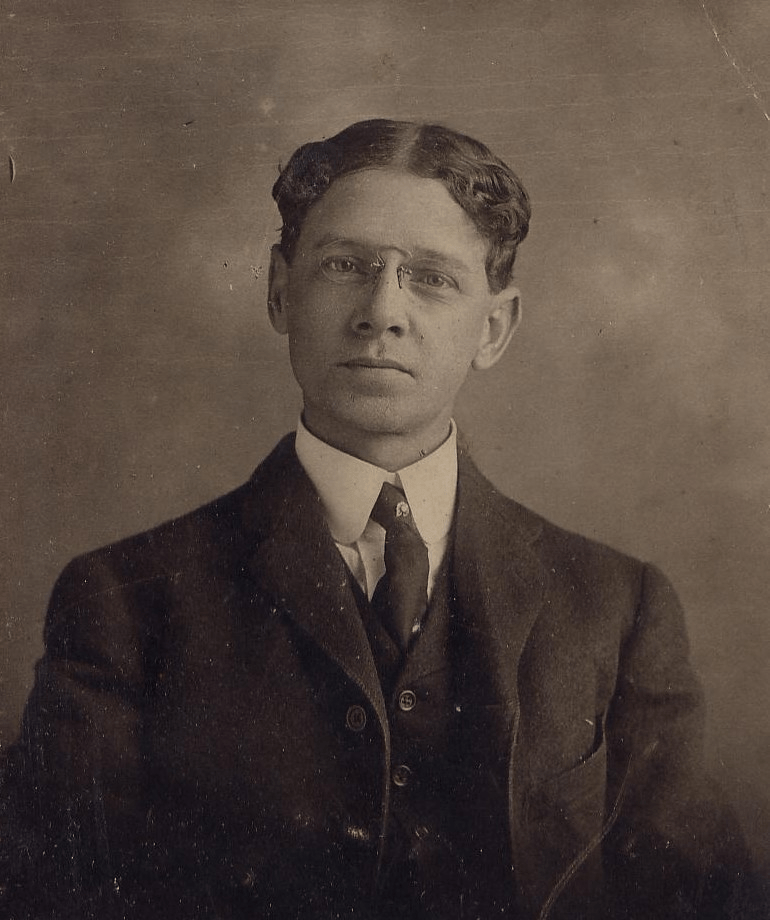
Their son, James Randolph Beard, is pictured below.
James Randolph Beard, Sr. January 1, 1894 (USPS Railway Mail Service Id)
Samuel Williams was born around 1820. He represented Harris County at the Georgia Constitutional Convention of 1867/68 and in the Georgia Assembly in 1868. He was married to Narcissa (or Narcissus) and had 2 children, Louisa and William. They lived in Hamilton, Georgia, the Harris County seat according to the 1870 Census since Samuel was 16 years old. Samuel is listed as having $200 in his personal estate and $200 in real estate with an occupation of “Rep Ligeslature [sic].” In 1874, Williams’s parents, Jourdan and Edie, are listed as also living with the family as well as Williams’s siblings Jourdan, Wesley, Elbot and Major. In 1880 Williams was 60/61 and Narcissa was 60. They still lived in Hamilton and Williams occupation is listed as a Blacksmith according to the census. Their daughter M.L Williams (23) is listed as living with them as well as grandchildren Lou (17) and Sam (10.)
Below is the Freedman’s Record for Samuel Williams from June 1, 1870. His was living Dekalb, County, GA, likely a few miles from the Georgia Capitol but his home county is listed as is Harris. Williams’s occupation is listed as “Blacksmith & Member of Legislature.” The census lists his two children, William and Louisa, as well as his siblings: four brothers “Jourdan, Wesley, Elbot and Major” and his 2 sisters, “Eelia” and “Esther.” Below the siblings reads the statement, “three brothers and sister dead.”
The census record shows Williams’s large family of three generations living in Dekalb county where he was serving in the legislature as well as the necessity of other employment while he served his county in the legislature.
Samuel Gardner represented Warren County, a rural county near Augusta. He was listed in the Georgia Weekly Telegraph as a local deacon at the Georgia Annual Conference of African M.E. Church held in Macon in March 1868. Gardner was removed from office along with the Black Republican legislators in 1869. An article published in the Atlanta Constitution on May 25,1869 lists Gardner as one of several Black assemblymen afraid to return to their homes in their elected counties due to threats of physical violence. Along with Gardner was Mr. Norris, Sheriff of Warren County.
In the 1870 census lists a Samuel Gardener, 52 (black,) working as a laborer and living in Atlanta Ward 2, Fulton, Georgia married to Leah Gardner, 38. They have 3 children, Roberts (17), Emma (16) and Nancy (12.) (See here.)
REFERENCES:
“People Who Are Afraid to Go Home.” Atlanta Constitution, May 25, 1868
“Georgia Annual Conference of African M.E. Church” The Georgia Weekly Telegraph March 20 1868 p. 4


 The Original 33