Alfred Richardson was born into slavery around 1836 in Walton County, Georgia, the son of Ross Richardson and Anna Richardson. He was brought to Clarke County at the age of seven, where he would spend the rest of his life. After emancipation, he worked as a carpenter and owned a tavern. A Freedman’s Bank record from 1871 lists his occupation as “House carpenter + Member of Legislature.” By 1870, census records show he had accumulated $250 in real estate and $150 in personal property.
On August 6, 1867, Richardson formally registered in Clarke County’s Election District 27, taking the oath required under Reconstruction to qualify as a voter and candidate. The following year, on Election Day in 1868, Alfred Richardson and Madison Davis became the first Black men elected to the Georgia General Assembly from Clarke County, each winning the majority of votes in Athens. As historian and politician Michael Thurmond described the scene, “White Athenians were shocked and dismayed. Black Athenians were overwhelmed with joy.” The two men took different approaches to their work. Local historian Matt Pulver characterized Davis as “more willing to play ball with the whites,” while Richardson “was having none of that. He was incredibly outspoken.”
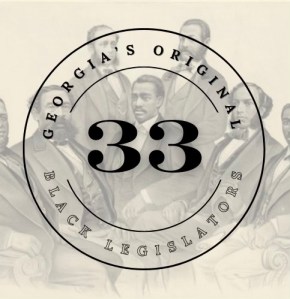
Along with the other Original 33 Black state lawmakers, Richardson was expelled from the legislature in 1868. He was reinstated in 1870 and continued serving in the Georgia General Assembly.
Richardson and his fellow legislators supported public schools for all children in Georgia, Black or white; advocated for the enfranchisement of white men who did not own property; and played a role in legislation seeking to enfranchise women.
Richardson’s outspokenness made him a target. He survived two Ku Klux Klan attacks in the same month on his home in Watkinsville. As reported by Emma Auer for NPR (June 30, 2026), drawing on Richardson’s Senate testimony and the account of his descendant Craig Crosby, one attack began between midnight and 1 a.m., when 15 to 25 men arrived at his home. Richardson had already reinforced his door, anticipating an assault, but the men broke through with an ax. He was shot three times and returned fire, killing one of his attackers. He later learned the man had been a childhood neighbor. Despite the ongoing danger, Richardson traveled to Washington to give testimony. In 1871, he told a U.S. Senate committee that it was not safe for him to return home and that he was staying in Athens, Georgia. That same year, while sheltering in Athens, he opened an account at the Freedman’s Bank, conducting business and asserting his place in civic life even amid the threats against him. Crosby has described his ancestor’s willingness to testify as a reflection of a lifelong commitment to doing “the right thing. No matter what the situation is, you stand up for what’s right.”
Alfred Richardson died of pneumonia in 1872, leaving no will. His wife, Fannie Harden Richardson, was appointed administrator of his estate, with fellow legislator Madison Davis and Floyd Hill serving as guarantors on a bond of $1,800, recorded March 12, 1872. Despite their differing political styles, Davis stood by Richardson’s family in a concrete way after his death. Fannie Richardson also died that year, leaving behind four daughters: Ella (1860–1943), Amanda (1863–1936), Laura (1866–1929), and Althea (1871–1935). By then, both of Richardson’s parents had already passed. He was survived by his brothers Isaac and Ross, who had settled in Atlanta, and his sisters Ellen and Lucy. The story of Athens’ first Black legislators was largely lost to history for more than a century. Thurmond, who in 1986 became the first Black lawmaker to represent the Athens area since Reconstruction, has said he was unaware of Richardson and Davis until he encountered them in a master’s thesis. Local activists are currently working to name Athens’ newest park after Richardson and Davis.
Sources:
1870 United States Federal Census, Watkinsville District, Clarke County, Georgia
Georgia, U.S., Returns of Qualified Voters and Reconstruction Oath Books, 1867–1869, Alfred Richardson, Clarke County, Election Precinct 2, August 6, 1867, https://www.ancestry.com/imageviewer/collections/1857/images/32305_1220706333_0104-00261?pId=923895
Georgia, U.S., Wills and Probate Records, 1742–1992, Administration Bond for Alfred Richardson, Clarke County, March 11, 1872, https://www.ancestry.com/imageviewer/collections/8635/images/005761594_00482?pId=68005
U.S., Freedman’s Bank Records, 1865–1874, Record No. 1409, Alfred Richardson, https://www.ancestry.com/imageviewer/collections/8755/images/GAM816_6-0188?pId=185928
Emma Auer, “America’s first Black legislators and the work to revive their legacies,” NPR/WUGA, June 30, 2026, https://www.npr.org/2026/06/30/nx-s1-5702833/americas-first-black-legislators-and-the-work-to-revive-their-legacies

